Career and Life Management - CALM-P10
LESSON = one official CALM specific outcome. 10-session bootcamp is a separate accelerated pathway and does not replace P10-P12, taxes, insurance, or the career capstone.
Canonical lesson CALM-U1-L10 · CALM-P10 · CURRICULUM_BASELINE
CALM-P10 - Examine various attitudes, values and behaviours for developing meaningful interpersonal relationships
- Course: CALM (PED0770) - Alberta Career and Life Management 2002
- Lesson ID:
CALM-U1-L10 - Unit:
U1- General Outcome 1: Personal Choices - Official outcome:
CALM-P10 - Object type: canonical lesson (not a bootcamp session)
- Bootcamp overlay: none (curriculum baseline) - overlay may *start* this outcome; it does not replace the full lesson
- Characters: fictional Cedar Bend, Jordan, Sam, River (never the student as a case study)
Official outcome text
examine various attitudes, values and behaviours for developing meaningful interpersonal relationships relationships; i.e., trust, integrity, respect, responsibility behaviours for building, maintaining and enhancing healthy, positive relationships change with age, growth and changes in life to others significant change and loss in a relationship and for ending a relationship unhealthy relationships and for dealing with exploitation and violence in relationships
Classroom restatement: Examine various attitudes, values and behaviours for developing meaningful interpersonal relationships.
Learning intention
Meet CALM-P10 with instruction, practice, and a check that is unique to this outcome. The 10-session bootcamp is a separate accelerated pathway. This file is the canonical lesson.
Students can succeed without disclosing private life. Pass is allowed on personal questions.
Success criteria
- Restate
CALM-P10in classroom language without swapping in a different CALM outcome’s worksheet. - Complete the worked-style task using only fictional Cedar Bend evidence and given numbers where money appears.
- Produce a FOUNDATION, CORE, PROFICIENT, or ADVANCED artifact as assigned.
- Use the privacy box: no required disclosure; private alternative where this outcome needs it.
Lesson ≠ bootcamp session
This is one official specific outcome. If a 10-session bootcamp file mentions CALM-P10, that file is an overlay starter only. Taxes, insurance, P10-P12, and the C11 capstone remain full-course lessons even when week-1 bootcamp is busy with other topics.
Sequenced ~75 minutes (adjust to the block)
- Diagnostic / retrieval (5 min) - Name one behaviour that builds trust in a team without telling a secret. Typical error: “share everything.”
- Teaching unique to
CALM-P10(15-18 min). - Diagram at the cue below (under 90 s showing time).
- Worked example with Jordan / Sam / River (12 min).
- Guided practice (12 min).
- Independent FOUNDATION→ADVANCED (15-18 min), including private/independent option.
- Misconception repair + exit ticket (8 min). Human-tutor handoff if crisis or privacy flags appear.
AKOS diagnostic / retrieval
Name one behaviour that builds trust in a team without telling a secret. Typical error: “share everything.”
Teaching (unique to CALM-P10)
This outcome examines attitudes, values, and behaviours for meaningful interpersonal relationships: trust, integrity, respect, responsibility; how relationships change with age and life events; ending a relationship; and recognizing unhealthy patterns including exploitation and violence - using fictional cases only. No required disclosure of the student’s relationships, family, orientation, or dating history. Classroom-shared work uses Cedar Bend personas. A private alternative is always available: the same analysis completed alone, submitted to the teacher only, or a non-relationship analogue (teammate/customer respect) if the school’s opt-out applies. Violence/exploitation: name public supports (counsellor, Kids Help Phone, 211); do not require survivors to teach the class. Pass is always allowed.
Do not invent FNMI content. Do not paste unrelated GTI chapters into this lesson. Do not reuse a mole worksheet, a different CALM outcome’s confession prompt, or a real household budget.
Diagram timing
When: after values list, ~50 s. What: simple respect/trust/responsibility triad - labelled as course ideas, not a student audit.
Keep figures simple (schedule strip, budget table, help-seeking map, comparison chart). Timed visuals are teaching aids, not decoration.
Worked example (Cedar Bend)
Fictional: Jordan and a coworker, Avery (not a student in the room), text after shifts. Avery pressures Jordan to share a private photo and to skip a family dinner. Analysis: respect and responsibility are missing; pressure is a warning pattern. Jordan’s options on the card: delay, say no, tell a trusted adult at school, use public help lines if scared. Students do not role-play the photo demand in detail. Private alternative: written analysis of the same card, or analyze kiosk customer respect instead.
Guided practice
Sort eight behaviours into build / maintain / harm using only the Avery card. No personal examples required.
Near-miss to repair: using a different outcome’s template (a P12 confession prompt in a money lesson, or a real family budget in a health lesson).
Independent practice
- FOUNDATION: Match trust / respect / responsibility to three lines on the fictional card.
- CORE: Write two signs of an unhealthy pattern from the card and one public support.
- PROFICIENT: Private option: complete the same table alone; or substitute teammate-respect scenarios.
- ADVANCED: Explain how ending a relationship can be a healthy skill without requiring students to narrate a breakup.
Independent (solo) students complete the same levels on the Cedar Bend kiosk brief or the private packet. No group is mandatory.
Privacy box
This lesson can touch sensitive topics. Shared class work uses a fictional persona card (Jordan, Sam, River, or another named card) - not a classmate’s private life. Pass is allowed on personal questions. Do not assign diagnoses, body measurements, sexual history, or trauma narratives for marks.
If someone volunteers something sensitive: thank them, stop the public share, and offer the private option or a counsellor. Crisis language → human supports (teacher/counsellor; 911 if immediate danger; Kids Help Phone 1-800-668-6868 / text CONNECT 686868; 211 Alberta). The AI Tutor is not a crisis service.
Shared project
This outcome does not require the micro-enterprise. Students continue the independent Cedar Bend kiosk option if they are in that stream, or skip project artifacts today.
Independent option remains available: solo kiosk brief, given numbers only.
Misconception to repair
Grading students on how much they disclose; using real classmates as case studies.
Tutor repair: name the wrong idea, give the classroom rule, return to the persona card. No shame.
AKOS instructional layer
| Function | In this lesson |
|---|---|
| Diagnostic | Retrieval prompt above; typical misconception named. |
| Outcome map | One official code: CALM-P10. Bootcamp overlay (if any) does not replace this lesson. |
| Sequenced lesson | Diagnostic → teach → diagram → worked → guided → independent levels → check. |
| Mastery check | FOUNDATION through ADVANCED products; not a diploma. |
| Misconception repair | Named below; tutor must not praise the wrong idea. |
| Tutor handoff | AI Tutor is not a counsellor. Human tutor / teacher / counsellor as specified. |
| Evidence capture | Exit ticket in the student folder; no crisis text in curriculum files. |
AI Tutor and human-tutor handoff
The AI Tutor grounds on CALM-P10 only. No false praise. No invented financial products, labs, or counselling protocols. No silent skip to a different outcome.
If a student writes about wanting to die, being unsafe, or being harmed: do not role-play therapy, do not ask for more trauma narrative, do not praise the disclosure as an assignment. Say you are not a crisis service. Name teacher, counsellor, 911 if immediate danger, Kids Help Phone 1-800-668-6868 / text CONNECT 686868, 211 Alberta. Hand off to a human.
Human tutor / teacher: privacy breach, crisis language, requests for real banking, sexual-history questions, or HCS3000 file uploads.
HCS3000
LINK_ONLY. Do not ingest, unzip, copy, or grade HCS3000 certificates, rosters, or module files in OEOM. Point students to the external course if the school offers it. CALM workplace talk stays at this lesson’s level.
Checks for understanding
- Restate
CALM-P10in classroom language without swapping another CALM outcome. - Case uses a persona card (or private packet) - not a classmate’s private story.
- Sensitive prompts were optional/pass-allowed; no trauma narrative required for marks.
Formative evidence
Collect the independent-practice artifact for CALM-P10. Three lines: (1) outcome in own words, (2) one persona-card fact used, (3) one thing that was not required today (e.g. personal disclosure).
Provenance
Official wording from Rapid-3 _official_math_calm_outcomes.json (CALM) aligned to ALBERTA_SENIOR_HIGH_OFFICIAL_OUTCOMES.csv. Lesson IDs match promote_full_courses.py calm_calendar() / canonical_lessons.json. Pack written as outcome-correct canonical markdown (lesson ≠ session).
Visual task (REMEDIATION_ONLY): Complete the fictional budget and justify one revision.
Open table abv-calm-0010 - CALM CALM U1 L10 budget table 010
Open full table (lazy). Alt: CALM CALM U1 L10 budget table 010. Full instructional budget table for CALM.
Visual task (DURING_LAB_ANALYSIS): Inspect the visual, notice labels, and answer the lesson prompt.
Open table abv-calm-0056 - CALM CALM U1 L10 planning table 056
Open full table (lazy). Alt: CALM CALM U1 L10 planning table 056. Full instructional planning table for CALM.
Visual task (DURING_DIRECT_INSTRUCTION): Inspect the visual, notice labels, and answer the lesson prompt.
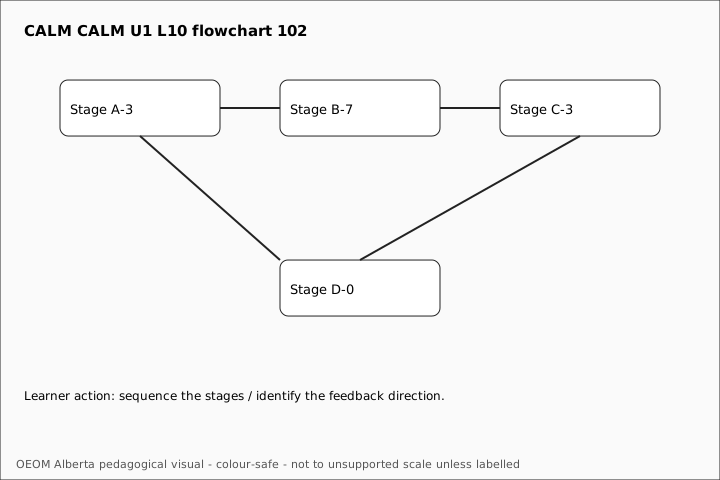
CALM CALM U1 L10 flowchart 102