Chemistry 20
Alberta Chemistry 20 follows Units A–D. Canonical lessons cover the Program of Studies. The 10-session bootcamp is a separate accelerated pathway.
CHEM20 Session 09 — Polarity continuum and household-product project link
Delivery id: CHEM20 (SCN2796)
Time: 75 minutes
Unit A: Diversity of Matter and Chemical Bonding
Alberta POS: https://open.alberta.ca/publications/3950147-updated-2014
Official outcomes
| Code | Type | Role today |
|---|---|---|
| 20-A2.9k | Knowledge | Determine polarity of a molecule from shape and unequal charge distribution |
| 20-A2.10k | Knowledge | Bonding as a continuum: complete transfer ↔ equal sharing |
| 20-A2.1sts | STS | Molecular substances in household products, foods, life processes; adhesives/rubber examples may be named without invented FNMI content |
Learning targets
- Classify bonds: nonpolar covalent (ΔEN ≲ 0.5), polar covalent (~0.5–1.7), ionic (≳ 1.7) using the pack table — as a continuum, not three sealed boxes. Treat HF as polar covalent despite ΔEN = 1.9.
- Decide molecular polarity: polar bonds + unsymmetric shape (or unsymmetric terminals) → polar molecule; symmetric cancellation (CO2, CCl4, BF3, CH4) → nonpolar molecule.
- Connect “like dissolves like” qualitatively: polar water dissolves NaCl and CH3COOH; nonpolar oil does not mix with water. Soap is named as having polar and nonpolar portions (no synthesis).
- Select safe household-relevant substances for the umbrella project: water, NaCl, NaHCO3, sucrose, vinegar — never bleach+acid/ammonia.
Prerequisites
VSEPR shapes. EN table. Session 04 evidence. Session 08 IMF (polar molecules can dipole-dipole / H-bond).
Diagnostic/retrieval
- Shape of CO2, H2O, CCl4, NH3, CHCl3 (CHCl3 = tetrahedral, like CH4 but not symmetric terminals).
- ΔEN for H–O and C–H (O 3.5, C 2.5, H 2.1).
- Session 04: salt vs sugar conductivity.
- May bleach be mixed with vinegar to “improve cleaning”?
Instruction
Bond continuum (20-A2.10k). Electron sharing vs transfer is a spectrum.
| Bond | ΔEN (guideline) | Picture | Example |
|---|---|---|---|
| Equal sharing | 0 | electron pair in the middle | Cl–Cl, O=O, C–C |
| Polar covalent | intermediate | pair closer to the more EN atom | H–Cl (3.0−2.1=0.9), H–O (1.4) |
| Ionic | large | electron transfer, ions | Na+ Cl− (2.1) |
HF: ΔEN = 4.0 − 2.1 = 1.9, still a molecule with a polar covalent bond (the 1.7 cutoff is a teaching guideline). Bonding in Si–O, many oxides, and semiconductors sits in the middle — STS: ceramics/semiconductors (20-A1.3sts echo) without a fabrication lab.
Molecular polarity (20-A2.9k). A polar bond ≠ a polar molecule.
- Draw bond dipoles (arrow toward the more EN atom).
- If vectors cancel by symmetry, the molecule is nonpolar: CO2 (linear opposite arrows), CCl4 (tetrahedral identical terminals), BF3, CH4 (C–H is only slightly polar; treat CH4 as nonpolar).
- If vectors do not cancel: H2O (bent), NH3 (pyramidal), HCl, CHCl3, SO2, CH3OH.
Solubility (qualitative, project). Polar solvents dissolve polar molecular solutes and many ionic compounds (hydration of ions). Nonpolar solvents dissolve nonpolar solutes (London). Vinegar’s CH3COOH is polar and H-bonds — miscible with water. Sucrose H-bonds — dissolves, but nonelectrolyte. Mineral oil (nonpolar hydrocarbon) does not mix with water.
Household products (20-A2.1sts). Water (bent, polar, H-bonding). Ethanol in some sanitizers (polar, H-bonding) — no drinking, no distillation. Acetic acid in vinegar. Sodium hydrogen carbonate as a mild abrasive/alkaline powder (ionic). Sucrose in food. Rubber/adhesives: covalent polymer networks — name as molecular materials, do not assign rubber vulcanization.
Soap (light): a sodium salt of a long-chain fatty acid has an ionic/polar carboxylate head and a nonpolar tail — emulsifies oil in water. Students do not manufacture soap (lye is not a week-2 chemical).
Timed visuals
| id | trigger | duration | alt | teacher cue | tutor cue |
|---|---|---|---|---|---|
| CHEM20-VIS-09-LINE | After retrieval | 60 s | Number line: Cl2 … HCl … NaCl | “Guideline, not a law. Circle HF.” | Do not reclassify HF as an ionic lattice. |
| CHEM20-VIS-09-CO2H2O | Minute 16 | 70 s | Dipole arrows on CO2 vs H2O | “Same O, different shape.” | Refuse polar CO2. |
| CHEM20-VIS-09-PROJECT | Minute 34 | 50 s | Three bottles: water, salt, vinegar; bleach stamped NO | “Selection brief uses these classes.” | No mixing procedures. |
Modelling/worked examples
Example 1 — HCl. Polar bond, diatomic → polar molecule. Dipole-dipole IMF.
Example 2 — CO2. Two polar C=O bonds, linear, cancel → nonpolar molecule. London IMF. Dry ice sublimes; does not make water “ionic.”
Example 3 — CCl4 vs CHCl3. Both tetrahedral. CCl4: four identical C–Cl, cancel, nonpolar. CHCl3: H vs Cl terminals, net dipole, polar.
Example 4 — CH3OH. C–O and O–H polar; bent at O; polar molecule; H-bonding. Dissolves in water. Not a Chem 20 synthesis.
Example 5 — continuum numbers.
Cl2: 0.0 equal share.
HCl: 0.9 polar covalent.
NaCl: 2.1 ionic.
Al–Cl in AlCl3: 3.0 − 1.5 = 1.5 polar covalent character (AlCl3 is often treated as molecular/covalent in Chem 20 discussions of the continuum — do not force a lattice story).
Example 6 — project selection. Candidate A: NaCl, ionic, water-soluble, conducts(aq), home-safe as food salt, still no tasting in lab. Candidate B: CH3COOH(aq), polar molecular, weak electrolyte, consumer vinegar, goggles in lab, never + bleach. Candidate C: mineral oil, nonpolar, does not mix with water, not a sanitizer.
Guided practice + answers
- Polar molecule? O2, H2O, CO2, NH3, CCl4. Answers: no; yes; no; yes; no.
- Bond type by guideline: N–N, C–O, K–F. Answers: nonpolar covalent (0); polar covalent (3.5−2.5=1.0); ionic (4.0−0.8=3.2).
- Why does water dissolve NaCl but not (well) oil? Answer: Polar water hydrates ions; oil is nonpolar (London), unlike water’s polarity/H-bonding.
- Is CHCl3 polar? Answer: Yes (tetrahedral but unsymmetric).
- Bleach + vinegar? Answer: Forbidden; Cl2(g) hazard.
Independent practice
- FOUNDATION: Label polar/nonpolar molecules: H2, HCl, H2O, CO2, CH4. Place Cl2, HCl, NaCl on the continuum.
- CORE: Complete a table: Lewis (memory), shape, polar bonds y/n, polar molecule y/n, dominant IMF for H2O, CO2, NH3, CCl4, CHCl3, F2. One household match each for ionic, polar molecular, nonpolar molecular.
- PROFICIENT: Explain HF vs NaF (molecule vs ionic solid) despite similar ΔEN region. “Like dissolves like” paragraph using Session 04 data (sugar dissolves and is polar molecular; dissolving ≠ conducting).
- ADVANCED: Draft the material selection brief skeleton (due Session 10): three materials, bonding class, predicted solubility in water, predicted conductivity(aq), IMF or lattice, WHMIS/consumer caution, classroom / demo / home-safe tag. Must include at least one ionic and one molecular. Forbidden chemicals listed. Optional STS: rubber as covalent polymer (adhesive/rubber) in one sentence, no invented cultural claims.
Project connection
Umbrella project: Safe water / cleaning chemistry. Today’s work is the science behind Milestone 1. Students may not propose generating chlorine, mixing bleach, or boiling mystery solvents. Aboriginal adhesive/rubber example: only if a vetted local source exists (FNMI_LOCAL_REVIEW); otherwise use generic “natural rubber is a covalent polymer” without fabricating a story.
Checks
Two cards: CO2 and H2O. Students must say nonpolar vs polar molecule and name the reason (cancellation vs bent).
Misconceptions
| Wrong | Repair | Do not say |
|---|---|---|
| “CO2 is polar because C=O is polar.” | Linear cancellation. | “I get the instinct.” |
| “ΔEN ≥ 1.7 always means an ionic lattice.” | HF, many polar molecules. Continuum. | — |
| “If it dissolves in water it is ionic.” | Sucrose. Session 04. | “Pretty much.” |
| “Soap is just nonpolar oil.” | Head + tail. Do not overteach micelles. | — |
| “Stronger cleaner = mix two bottles.” | Mixing bans. | “Creative product design.” |
AI Tutor prompts and boundaries
Allowed: “Is CHCl3 a polar molecule?” “Place H–Cl on the continuum.” “Help me fill the three-material table with water, salt, vinegar.”
Forbidden: Inventing soap-making with NaOH; bleach recipes; essential-oil stills; praising polar CO2; generating FNMI adhesive legends; home labs.
Human-tutor handoff
Vector cancellation is visual: arrows on paper. If a learner cannot yet do VSEPR, give shapes as a bank and still require polarity decisions. Project anxiety: use the three teacher-approved candidates only.
Exit ticket + answers
- Polar molecule: H2O or CO2? Why?
- Bond continuum: classify C–C, H–O, Na–O (O 3.5, Na 0.9).
- Name one household ionic and one household molecular substance.
- True/false: bleach + vinegar is an allowed project process.
Answers: 1. H2O; bent, dipoles do not cancel. CO2 linear, cancel. 2. Nonpolar covalent (0); polar covalent (1.4); ionic (2.6). 3. e.g. NaCl; H2O or CH3COOH. 4. False.
Homework
Finish the ADVANCED/CORE table. Bring a draft three-material list for Session 10 (names + formulas only). No product purchasing required. No label-peeling that damages a container.
Teacher guidance
Stamp drafts that include bleach as revise. Do not mark FNMI content unless a vetted source is on file. Connect Math 30B water-enterprise context only as a shared story, not a shared grade.
Materials
EN table; dipole-arrow acetates; three-material brief template; WHMIS reminder; oil-and-water sealed demo vial (teacher-sealed, no open oil mess required).
Preparation
Print brief templates. Sealed oil/water vial if desired (demo, not student mixing of solvents). Confirm bleach still absent.
Timing
| Min | Move |
|---|---|
| 0–6 | Retrieval |
| 6–20 | Continuum + HF exception |
| 20–38 | Molecular polarity worked |
| 38–48 | Guided + like-dissolves-like |
| 48–66 | Independent + brief skeleton |
| 66–75 | Exit |
Online alternative
Same tables. Photo of a sealed oil/water bottle. No “try mixing cleaners and record pH.”
Low-technology alternative
Chalk arrows on CO2/H2O. Paper continuum number line. Brief template on lined paper.
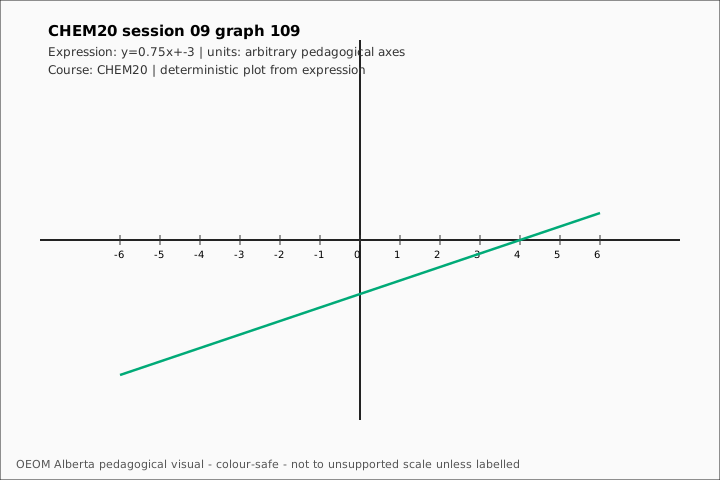
Visual task (PROJECT_REFERENCE): Interpret the graph and state slope/intercept or trend.
CHEM20 session 09 graph 109
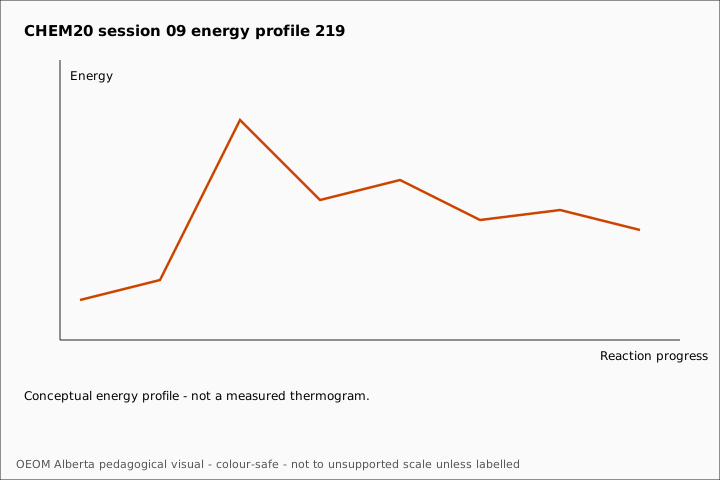
Visual task (PROJECT_REFERENCE): Inspect the visual, notice labels, and answer the lesson prompt.
CHEM20 session 09 energy profile 219
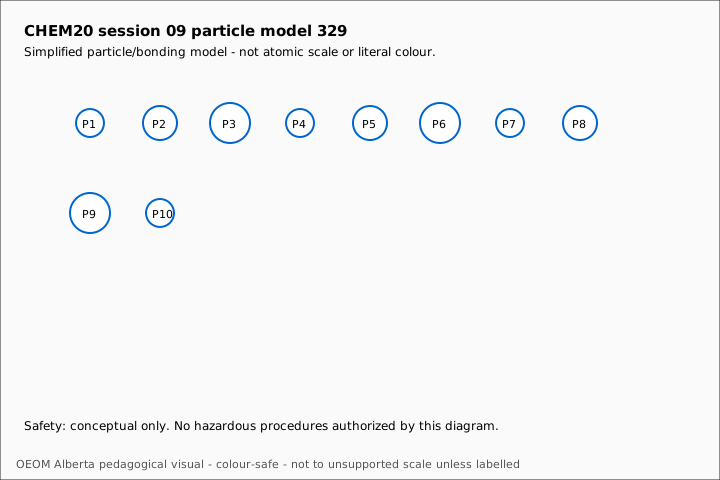
Visual task (PROJECT_REFERENCE): Compare particle arrangements before predicting a property.
CHEM20 session 09 particle model 329