Chemistry 20
Alberta Chemistry 20 follows Units A–D. Canonical lessons cover the Program of Studies. The 10-session bootcamp is a separate accelerated pathway.
CHEM20 Session 07 — VSEPR shapes
Delivery id: CHEM20 (SCN2796)
Time: 75 minutes
Unit A: Diversity of Matter and Chemical Bonding
Alberta POS: https://open.alberta.ca/publications/3950147-updated-2014
Official outcomes
| Code | Type | Role today |
|---|---|---|
| 20-A2.5k | Knowledge | Apply VSEPR to predict linear, angular (V-shaped, bent), tetrahedral, trigonal pyramidal, trigonal planar |
| 20-A2.6k | Knowledge | Illustrate by drawing or building models of simple molecular substances |
| 20-A2.4k | Knowledge | Lewis structures as the input to VSEPR |
Learning targets
- State VSEPR: valence-shell electron pairs (bonding and lone) repel and occupy positions that maximize separation.
- Assign AXE notation (A = central, X = bonded atoms, E = lone pairs on central atom) and the five Chem 20 shapes.
- Predict shapes for CO2, BeCl2 (linear), BF3 or H2CO (trigonal planar), CH4 / CCl4 (tetrahedral), NH3 (trigonal pyramidal), H2O / SO2 (bent), HCN (linear).
- Build or draw 3-D representations; a 2-D Lewis diagram is not the molecular shape.
Prerequisites
Session 06 Lewis structures. Lone pairs on the central atom matter; lone pairs on terminal atoms do not change AXE.
Diagnostic/retrieval
- Lewis of H2O: how many lone pairs on O?
- Lewis of CO2: how many lone pairs on C?
- Is O=C=O “bent” because we drew it on a V on paper?
- Electron total for NH3.
Instruction
VSEPR theory (Chem 20). Electron domains around the central atom occupy space. A domain is a single, double, or triple bond (each counts as one domain) or a lone pair.
Five required shapes:
| AXE | Domains | Shape name | Bond angle (ideal) | Examples |
|---|---|---|---|---|
| AX2 | 2 | linear | 180° | CO2, HCN, BeCl2 |
| AX3 | 3 | trigonal planar | 120° | BF3, H2CO (approx.) |
| AX4 | 4 | tetrahedral | 109.5° | CH4, CCl4, NH4+ |
| AX3E | 4 | trigonal pyramidal | ~107° | NH3, PCl3 |
| AX2E2 | 4 | angular / V-shaped / bent | ~104.5° | H2O |
| AX2E | 3 | angular / bent | ~120° | SO2 |
Name angular, V-shaped, and bent as the same Chem 20 family (20-A2.5k wording).
Lone pairs occupy more space than bonding pairs, so NH3 and H2O angles are slightly less than 109.5°. CORE should state the ideal geometry name; PROFICIENT should mention the compression.
Multiple bonds: CO2 is AX2 (two domains), linear, even though each domain is a double bond. Do not call CO2 tetrahedral.
Ionic lattices have no VSEPR molecule shape. NaCl is not “linear.”
Timed visuals
| id | trigger | duration | alt | teacher cue | tutor cue |
|---|---|---|---|---|---|
| CHEM20-VIS-07-DOMAIN | After retrieval | 50 s | Balloon pairs (photo) | “Balloons = domains, including lone pairs.” | Do not require real balloons if latex allergy. |
| CHEM20-VIS-07-FIVE | Minute 14 | 70 s | Five-shape poster | Point to bent vs linear | Refuse CO2 as bent. |
| CHEM20-VIS-07-NH3 | Minute 26 | 45 s | NH3 model, lone pair as a stick with no atom | “The lone pair is why it is not trigonal planar.” | — |
Modelling/worked examples
Example 1 — CO2. Lewis O=C=O. Central C: 2 bonding domains, 0 lone pairs → AX2 → linear, 180°.
Example 2 — BF3. 24 e; three B–F singles (Chem 20 accepts BF3 as trigonal planar AX3; B has 6 e — exception named). Shape: trigonal planar, 120°.
Example 3 — CH4. AX4, tetrahedral, 109.5°. A flat square drawing is wrong.
Example 4 — NH3. Lewis: 3 bonding pairs + 1 lone pair on N → AX3E → trigonal pyramidal, not tetrahedral (the electron-pair geometry is tetrahedral; the molecular shape names the atom positions).
Example 5 — H2O. AX2E2 → bent. Electron-pair geometry tetrahedral; molecular shape bent.
Example 6 — SO2. Lewis (one acceptable Chem 20 form): S with a double bond, a single bond, and a lone pair → AX2E → bent.
Example 7 — CCl4 vs CHCl3. Both have four domains on C (no lone pairs) → tetrahedral electron/molecular shape. Polarity differs (Session 09); shape name is still tetrahedral.
Guided practice + answers
- Shape of HCN. Answer: linear (AX2).
- Shape of PCl3. Answer: trigonal pyramidal (AX3E).
- Why is H2O not linear like CO2? Answer: O has two lone pairs (AX2E2); C in CO2 has none (AX2).
- Shape of CCl4. Answer: tetrahedral.
- Name the shape for AX3. Answer: trigonal planar.
Independent practice
- FOUNDATION: Complete a table: molecule, Lewis (given), AXE, shape for CO2, CH4, H2O, NH3.
- CORE: Predict without a given Lewis: BF3, H2S (like water, bent), PCl3, HCN, CCl4. Draw a 3-D wedge/dash for CH4.
- PROFICIENT: Distinguish electron-pair geometry vs molecular shape for NH3 and H2O. Explain why a double bond in CO2 counts as one domain. Predict SO2 as bent.
- ADVANCED: Build kit models (or paper tetrahedra) for CH4, NH3, H2O and photograph or sketch. One paragraph: why VSEPR does not apply to NaCl(s). Optional: H2CO (methanal) AX3 trigonal planar around C.
Project connection
Water is bent — that geometry is required for a polar molecule and for dissolving ionic cleaners (Session 09). CO2 is linear — polar bonds cancel. Record shapes of H2O, NH3 (if used as a banned household mixer with bleach — ammonia is not a project chemical). Ammonia is a VSEPR example only, not a selected cleaner.
Checks
Show CO2 card: students hold arms 180° vs 104°. If anyone “bends” CO2 because of the two oxygens, freeze and reteach domains.
Misconceptions
| Wrong | Repair | Do not say |
|---|---|---|
| “Lewis drawing is the shape.” | Lewis is connectivity; VSEPR is 3-D. | “Yours looks artistic.” |
| “CO2 is bent like water.” | No lone pairs on C; AX2 linear. | — |
| “NH3 is tetrahedral because 4 pairs.” | Electron-pair geometry tetrahedral; molecular shape trigonal pyramidal. | “Same thing.” |
| “Triple bonds count as three domains.” | One domain. | — |
| “NaCl is linear VSEPR.” | Ionic lattice, no molecule. | — |
AI Tutor prompts and boundaries
Allowed: “AXE and shape for H2O, NH3, CO2, CH4, BF3.” “Why is a double bond one domain?”
Forbidden: Inventing a boiling-water shape lab; ammonia+bleach; praising bent CO2; generating extra shapes (octahedral, T-shape) as CORE required.
Human-tutor handoff
Fine-motor: teacher-built models, student labels. ELL: keep the three bent synonyms posted. If balloon demo is used, non-latex only.
Exit ticket + answers
- Shape of CH4.
- Shape of H2O.
- Shape of CO2.
- AXE for NH3.
Answers: 1. tetrahedral. 2. bent / angular / V-shaped. 3. linear. 4. AX3E.
Homework
Draw wedge/dash sketches for the CORE list. Read: polar vs nonpolar teaser (one sentence in notebook: “shape + EN decide polarity”).
Teacher guidance
Grade the name of the molecular shape, not artistic talent. Require AXE on CORE. Do not distribute ammonia as a “real bottle” for the project.
Materials
Model kits or marshmallow/toothpick food items not to be eaten in lab; five-shape poster; wedge/dash handout. Marshmallows: if used, classroom models only, discarded, no eating (lab glassware contamination).
Preparation
Allergy check (latex balloons, marshmallow gelatin). Print AXE table. Count kit pieces.
Timing
| Min | Move |
|---|---|
| 0–6 | Retrieval |
| 6–20 | VSEPR + five shapes + AXE |
| 20–38 | Worked models |
| 38–50 | Guided |
| 50–66 | Independent + kits |
| 66–75 | Exit |
Online alternative
PhET *Molecule Shapes* (approved list) with a screenshot of CO2, H2O, NH3, CH4, BF3. Same table.
Low-technology alternative
Paper tetrahedron net; gumdrops forbidden if they will be eaten. Pipe cleaners: four arms, fold lone pairs down.
Visual task (AFTER_PRACTICE): Inspect the visual, notice labels, and answer the lesson prompt.
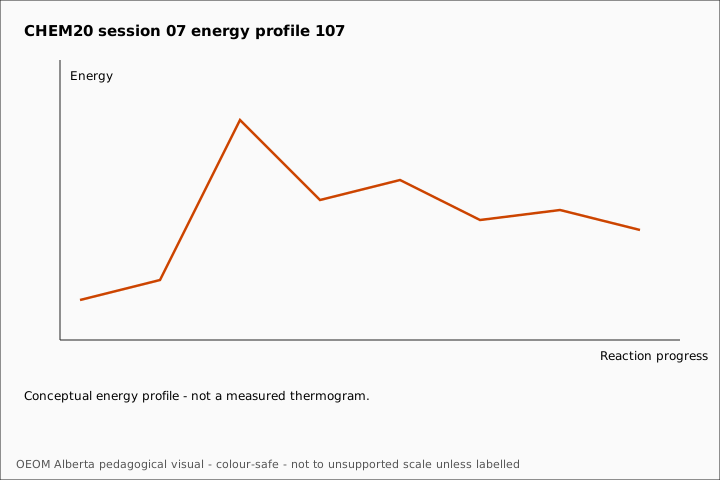
CHEM20 session 07 energy profile 107
Visual task (AFTER_PRACTICE): Compare particle arrangements before predicting a property.
CHEM20 session 07 particle model 217
Visual task (AFTER_PRACTICE): Inspect the visual, notice labels, and answer the lesson prompt.
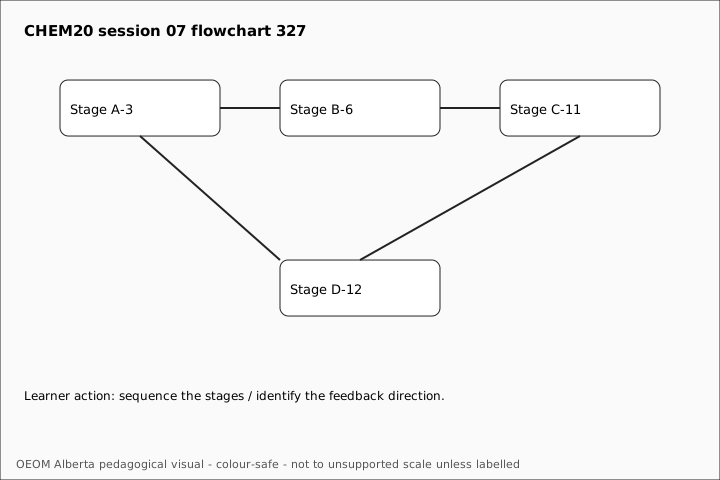
CHEM20 session 07 flowchart 327