Chemistry 20
Alberta Chemistry 20 follows Units A–D. Canonical lessons cover the Program of Studies. The 10-session bootcamp is a separate accelerated pathway.
CHEM20 Session 06 — Covalent bonding, Lewis structures, electron pairing
Delivery id: CHEM20 (SCN2796)
Time: 75 minutes
Unit A: Diversity of Matter and Chemical Bonding
Alberta POS: https://open.alberta.ca/publications/3950147-updated-2014
Official outcomes
| Code | Type | Role today |
|---|---|---|
| 20-A2.3k | Knowledge | Relate electron pairing to single, double, triple covalent bonds |
| 20-A2.4k | Knowledge | Draw electron-dot diagrams of atoms and molecules; structural formulas; Lewis structures for simple molecules |
Learning targets
- Define a covalent bond as a shared electron pair (intramolecular) between nuclei.
- Draw Lewis structures and structural formulas for H2, Cl2, O2, N2, HCl, H2O, NH3, CH4, CO2, HCN, C2H4 (ethene, double bond), C2H2 (ethyne, triple bond).
- Count bonding pairs vs lone pairs; state that O2 is O=O (double) and N2 is N≡N (triple).
- Use the octet (duet for H) as a bookkeeping rule, not a moral “want.”
Prerequisites
Valence electrons (Session 01). Molecular formulas (Session 05). No flames; no synthesizing gases.
Diagnostic/retrieval
- Valence electrons in C, N, O, F, H.
- Name N2O4.
- Ionic or molecular: CO2, NaCl, CCl4.
- How many electrons are in one shared pair?
Instruction
Covalent bond: attraction of two nuclei to a shared pair of electrons. That sharing is intramolecular. Multiple bonds = multiple shared pairs.
| Bond | Shared pairs | Example | Bond order |
|---|---|---|---|
| Single | 1 | H–H, Cl–Cl, H–Cl, C–H | 1 |
| Double | 2 | O=O, O=C=O, H2C=CH2 | 2 |
| Triple | 3 | N≡N, H–C≡N, H–C≡C–H | 3 |
Lewis algorithm (Chem 20 simple molecules):
- Count total valence electrons.
- Skeleton: least EN atom central (never H central). C is central in CO2 and CH4; N in NH3; O in H2O.
- Place single bonds (2 e each).
- Fill octets on terminal atoms (H duet).
- Place leftover electrons on central atom.
- If central atom lacks octet, convert lone pairs on terminals into multiple bonds.
Worked electron counts:
- H2: 1+1 = 2 e → H:H or H–H.
- Cl2: 7+7 = 14 e → single bond + 6 lone pairs.
- O2: 6+6 = 12 e → double bond (each O has 2 lone pairs). (Chem 20 does not require MO theory or the paramagnetism story.)
- N2: 5+5 = 10 e → triple bond, one lone pair on each N.
- H2O: 6+1+1 = 8 e → O with two bonds and two lone pairs.
- CO2: 4+6+6 = 16 e → O=C=O, two lone pairs on each O.
- CH4: 4+4×1 = 8 e → four C–H singles.
- NH3: 5+3 = 8 e → three N–H plus one lone pair on N.
- HCN: 1+4+5 = 10 e → H–C≡N with a lone pair on N.
Structural formula shows bonds as lines; Lewis shows all lone pairs. Both are required at CORE.
Not today: full formal charge accounting except as ADVANCED optional check; expanded octets (PCl5, SF6) wait until the teacher explicitly opens them — mention that PCl5 exists (Session 05 name) but do not demand a Lewis octet for it in CORE.
Timed visuals
| id | trigger | duration | alt | teacher cue | tutor cue |
|---|---|---|---|---|---|
| CHEM20-VIS-06-PAIR | After retrieval | 45 s | Two electrons in one line = single bond | “A pair is two electrons.” | Do not say “atoms share to be happy.” |
| CHEM20-VIS-06-N2 | Minute 16 | 50 s | N≡N with lone pairs | “Six electrons between the nuclei.” | Quote 10 valence e total. |
| CHEM20-VIS-06-CO2 | Minute 24 | 55 s | O=C=O vs O–C–O with octets failing | “Singles leave C with 4 e — illegal here.” | Refuse O–C–O as final CO2. |
Modelling/worked examples
Example 1 — O2. Valence 12. O–O single would leave each O needing more; forming a double bond uses 4 e in the bond region; remaining 8 e = four lone pairs, two on each O. Structural: O=O.
Example 2 — CO2. 16 e. C central, two O. Singles use 4 e; filling O octets uses 12 more = 16, but C has only 4 e. Move one lone pair from each O to form two double bonds. C now has 8 e. Structural: O=C=O.
Example 3 — H2O. 8 e. O central, two H. Two single bonds (4 e); remaining 4 e = two lone pairs on O. Structural: H–O–H (bent shape is Session 07).
Example 4 — C2H4. 2×4 + 4×1 = 12 e. Skeleton H2C–CH2 with a C–C single and four C–H uses 10 e; remaining 2 e make the C–C a double bond. Each C has 8 e.
Non-example: drawing NaCl as Na–Cl with a shared pair. That is the wrong bond type for Chem 20 ionic compounds.
Guided practice + answers
- Lewis and structural for HCl. Answer: 8 e; H–Cl with 3 lone pairs on Cl.
- Lewis for N2. Answer: :N≡N: (each N one lone pair).
- Total valence electrons in NH3? Answer: 8.
- Why does CH4 have no lone pairs on C? Answer: 8 e all used in four C–H bonds.
- Identify bond type in O2 vs F2. Answer: double vs single.
Independent practice
- FOUNDATION: Lewis + structural for H2, Cl2, HCl, CH4. Count valence electrons for each.
- CORE: H2O, NH3, CO2, N2, O2. For each: electron total, bonding pairs, lone pairs on the central atom (or on each atom for diatomics).
- PROFICIENT: HCN and C2H2 (H–C≡C–H). Show why a C–C single in C2H2 fails the electron count (10 e total for C2H2: 2×4+2×1=10; six C–H and C–C singles would need 6×2=12 e).
- ADVANCED: Lewis for SO2 (18 e, S central, resonance optional: one double and one single with formal charge, or two doubles if the teacher allows expanded S). State that Chem 20 CORE does not require resonance language; if drawn, do not invent a lab to “see resonance.” Project: Lewis of H2O and CO2 as candidates — different bonding, different polarity next sessions.
Project connection
Water’s two lone pairs and two bonds set up bent shape and polarity (07–09) — that is why water dissolves NaCl. CO2’s double bonds set up linear shape and a nonpolar molecule despite polar bonds. No lab.
Checks
Mini-whiteboard: electron total for CO2. If 22, they added 6 for C. Repair: C has 4 valence electrons.
Misconceptions
| Wrong | Repair | Do not say |
|---|---|---|
| “O2 is O–O because oxygen likes two bonds wait no two singles.” | Electron count 12 forces a double bond in the Lewis octet model. | “Close.” |
| “Lone pairs are ionic.” | Lone pairs are unshared electrons on an atom in a molecule. | — |
| “C can be happy with 4 electrons.” | Carbon in these molecules has an octet. | “Good enough for now.” |
| “Lewis structures prove the molecule is ionic if dots move.” | Dots in covalent Lewis are shared or lone; transfer was Session 03. | — |
| “Draw extra hydrogens to use leftover electrons.” | H is never central and never has 4 bonds in this course. | — |
AI Tutor prompts and boundaries
Allowed: “Count valence electrons in CO2 and place the double bonds.” “Lewis for NH3.”
Forbidden: Generating PCl5/SF6 CORE keys unless the student is ADVANCED and the teacher allowed expanded octets; home gas generation (H2, Cl2, HCN — HCN is toxic, never a lab here); false praise for Na–Cl covalent; inventing a “Lewis structure lab” with chemicals.
Human-tutor handoff
Dysgraphia: accept typed Lewis using H-O-H plus a note “2 lone pairs on O.” If electron totals consistently wrong, return to the periodic-group valence chart.
Exit ticket + answers
- Lewis / structural for N2.
- How many bonding pairs in CO2?
- Electron total for H2O.
- Single, double, or triple: bond in O2.
Answers: 1. :N≡N: 2. Four bonding pairs (two double bonds). 3. 8. 4. Double.
Homework
Draw Lewis for the CORE list from memory. Preview: guess whether H2O and CO2 are the same shape (Session 07).
Teacher guidance
Do not open hydrogen cyanide as a demo. HCN is a paper structure only. Watch for students searching “make nitrogen gas at home.”
Materials
Lewis worksheets with electron-count boxes; model kits if available (optional); valence chart.
Preparation
Print electron-count boxes. Decide whether ADVANCED SO2 resonance is offered (recommended: one structure only).
Timing
| Min | Move |
|---|---|
| 0–6 | Retrieval |
| 6–22 | Pairing, single/double/triple, algorithm |
| 22–40 | Worked H2, O2, N2, H2O, CO2, CH4 |
| 40–52 | Guided |
| 52–66 | Independent |
| 66–75 | Exit |
Online alternative
Approved molecule-drawing app or paper photo upload. Tutor may check electron totals only against the class list.
Low-technology alternative
Coins = electrons. Learners physically pair coins into bonds and leftover piles (lone pairs) on a paper atom map.
Visual task (DURING_LAB_ANALYSIS): Match apparatus parts to the procedure steps (simulation/demo only).
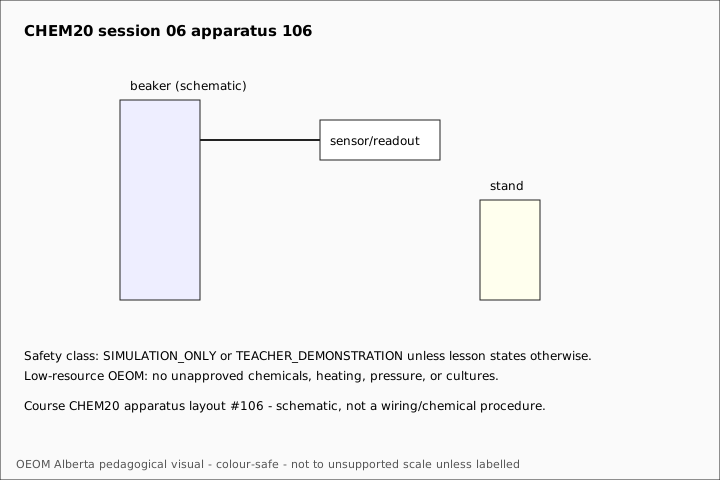
CHEM20 session 06 apparatus 106
Visual task (DURING_LAB_ANALYSIS): Inspect the visual, notice labels, and answer the lesson prompt.
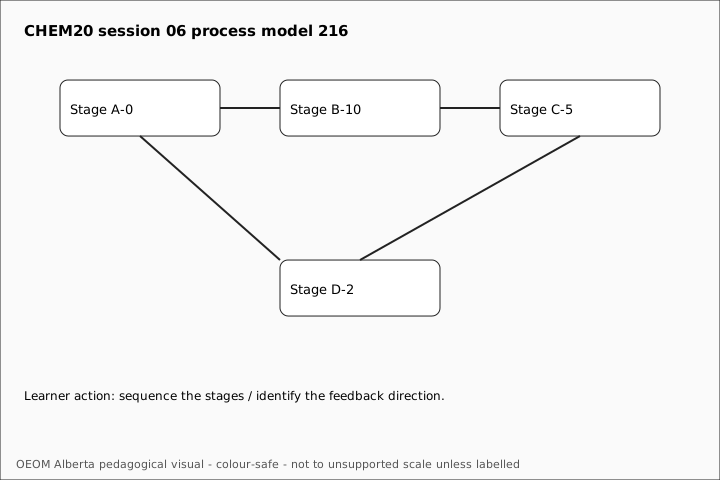
CHEM20 session 06 process model 216
Visual task (DURING_LAB_ANALYSIS): Inspect the visual, notice labels, and answer the lesson prompt.
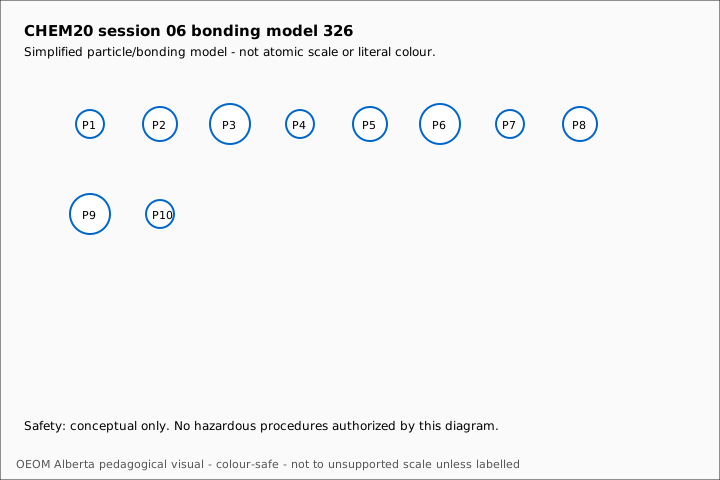
CHEM20 session 06 bonding model 326