Chemistry 20
Alberta Chemistry 20 follows Units A–D. Canonical lessons cover the Program of Studies. The 10-session bootcamp is a separate accelerated pathway.
CHEM20 Session 05 — Molecular naming and formulas
Delivery id: CHEM20 (SCN2796)
Time: 75 minutes
Unit A: Diversity of Matter and Chemical Bonding
Alberta POS: https://open.alberta.ca/publications/3950147-updated-2014
Official outcomes
| Code | Type | Role today |
|---|---|---|
| 20-A2.1k | Knowledge | Recall principles for assigning names to molecular substances |
| 20-A2.2k | Knowledge | Explain why molecular formulas state the number of atoms of each element |
| 20-A1.1k | Knowledge | Contrast: ionic names do not use mono/di/tri |
Acids as a naming system are Unit C (20-C2.1k). Today: binary molecular compounds and a few common molecules (H2O, NH3, CH4) by accepted names.
Learning targets
- Name binary molecular compounds with prefixes mono–deca (drop redundant “mono” on the first element; monoxide not monooxide).
- Write formulas from names: dinitrogen tetroxide is \( \mathrm{N}_{2}\mathrm{O}_{4} \), not “the ionic ratio.”
- Explain why \( \mathrm{H}_{2}\mathrm{O}_{2} \) is not written HO: the molecular formula counts atoms in the molecule, which may not be the empirical ratio.
- Distinguish CO vs CO2, NO vs NO2, PCl3 vs PCl5 as different substances.
Prerequisites
Sessions 01–04. Ionic naming must not be overwritten. Sugar from Session 04 is molecular C12H22O11.
Diagnostic/retrieval
- Name Na2O. (Ionic: sodium oxide — trap for people who write “disodium monoxide.”)
- Formula for iron(III) sulfate.
- Session 04: did sucrose conduct?
- How many oxygen atoms in one molecule of CO2?
Instruction
Molecular substances are made of discrete molecules held by covalent bonds (Sessions 06–08). The formula is a molecular formula: it reports how many atoms of each element are in one molecule.
Prefix system (binary molecular, two non-metals):
| n | prefix | n | prefix |
|---|---|---|---|
| 1 | mono | 6 | hexa |
| 2 | di | 7 | hepta |
| 3 | tri | 8 | octa |
| 4 | tetra | 9 | nona |
| 5 | penta | 10 | deca |
Rules used in Chem 20:
- Second element ends in -ide.
- Prefix on both elements as needed: \( \mathrm{N}_{2}\mathrm{O}_{5} \) dinitrogen pentoxide (pentoxide, not pentaoxide, by common Chem 20 convention).
- Omit mono- on the first element: CO carbon monoxide, not monocarbon monoxide.
- Never use prefixes for ionic NaCl.
Why molecular formulas are not always empirical (20-A2.2k).
Hydrogen peroxide molecules are H–O–O–H: molecular formula \( \mathrm{H}_{2}\mathrm{O}_{2} \), empirical HO. Glucose \( \mathrm{C}_{6}\mathrm{H}_{12}\mathrm{O}_{6} \), empirical \( \mathrm{CH}_{2}\mathrm{O} \). Ionic NaCl is already empirical.
Session 04 sugar: sucrose \( \mathrm{C}_{12}\mathrm{H}_{22}\mathrm{O}_{11} \) is already the molecular formula (empirical is the same in that case).
Accepted names (do not prefix these as if they were binary invented names): H2O water, NH3 ammonia, CH4 methane, O3 ozone. H2O2 hydrogen peroxide (not “dihydrogen dioxide” in this course’s required list — mention it exists as a systematic option, CORE uses hydrogen peroxide).
Different formulas, different compounds: CO (carbon monoxide, toxic) vs CO2 (carbon dioxide). PCl3 phosphorus trichloride vs PCl5 phosphorus pentachloride.
Timed visuals
| id | trigger | duration | alt | teacher cue | tutor cue |
|---|---|---|---|---|---|
| CHEM20-VIS-05-PREFIX | After retrieval | 50 s | Prefix tower 1–10 | “Count atoms, not charges.” | Refuse criss-cross on CO2. |
| CHEM20-VIS-05-H2O2 | Minute 18 | 55 s | H2O2 vs HO vs H2O ball models | “Same empirical ratio as HO; different molecule from water.” | No home peroxide labs. |
| CHEM20-VIS-05-TRAP | Minute 28 | 40 s | Na2O card stamped IONIC | “No prefixes on salts.” | Flag disodium monoxide as incorrect for Chem 20 ionic names. |
Modelling/worked examples
Example 1. \( \mathrm{PCl}_{5} \): phosphorus pentachloride. Five Cl atoms, one P atom in each molecule.
Example 2. Dinitrogen monoxide: \( \mathrm{N}_{2}\mathrm{O} \) (also called nitrous oxide — accepted common name; CORE accepts N2O as dinitrogen monoxide).
Example 3. \( \mathrm{Cl}_{2}\mathrm{O}_{7} \): dichlorine heptoxide.
Example 4 — 20-A2.2k. A student “simplifies” \( \mathrm{N}_{2}\mathrm{O}_{4} \) to \( \mathrm{NO}_{2} \). Those are different molecules (dinitrogen tetroxide vs nitrogen dioxide) in equilibrium in advanced chemistry; in Chem 20, do not reduce molecular formulas. Ionic \( \mathrm{Na}_{2}\mathrm{O}_{2} \) vs \( \mathrm{NaO} \) was a different issue; here the molecule really contains 2 N and 4 O.
Example 5 — project. Carbon dioxide is molecular, nonpolar molecule (Session 09), not a cleaner. Ethanol \( \mathrm{C}_{2}\mathrm{H}_{5}\mathrm{OH} \) (or C2H6O) is molecular; naming as an alcohol is beyond binary prefixes — record it as a named household molecule, not “dicarbon hexahydrogen monoxide.”
Guided practice + answers
- Name \( \mathrm{SO}_{2} \), \( \mathrm{SO}_{3} \), \( \mathrm{CCl}_{4} \). Answers: sulfur dioxide; sulfur trioxide; carbon tetrachloride.
- Formulas: dinitrogen trioxide; phosphorus trifluoride; iodine heptafluoride. Answers: \( \mathrm{N}_{2}\mathrm{O}_{3} \); \( \mathrm{PF}_{3} \); \( \mathrm{IF}_{7} \).
- Why is water not “dihydrogen monoxide” on the required list? Answer: Accepted name is water; the joke name is chemically prefix-legal but not how we assess H2O.
- Why not write \( \mathrm{H}_{2}\mathrm{O}_{2} \) as HO? Answer: The molecule contains two H and two O; empirical HO hides the actual molecule (and would collide with a hypothetical different species).
- Name \( \mathrm{NaCl} \) using ionic rules. Answer: sodium chloride (not sodium monochloride).
Independent practice
- FOUNDATION: Name CO2, NO2, PCl3. Formulas: carbon monoxide, sulfur dioxide, dinitrogen pentoxide. One sentence: prefixes count atoms.
- CORE: Name N2O4, Cl2O, P4O10 (tetraphosphorus decaoxide). Formulas: xenon hexafluoride, dichlorine monoxide, nitrogen monoxide. Contrast Na2O vs N2O naming systems. Explain H2O2 vs HO.
- PROFICIENT: A label says “nitrogen oxide.” Explain why that is ambiguous (NO, NO2, N2O, N2O4, N2O5…). Write correct names for NO and NO2. For C6H12O6, state molecular vs empirical formula.
- ADVANCED: Project brief seed: list three molecular substances in household cleaning/water context (H2O, CH3COOH in vinegar, C2H5OH if the school permits discussing ethanol as a solvent — no drinking, no distillation). For each, write the molecular formula and why an ionic Stock name would be wrong.
Project connection
Vinegar’s acetic acid is molecular \( \mathrm{CH}_{3}\mathrm{COOH} \) (often written HC2H3O2). Session 04 weak conductivity is consistent with a molecular acid, not with “vinegar is salt.” Add H2O as the solvent, not as a “named binary practice item.”
Checks
Board: “Name BCl3.” Expected boron trichloride. If “boron chloride,” demand the prefix because boron and chlorine are both non-metals (binary molecular).
Misconceptions
| Wrong | Repair | Do not say |
|---|---|---|
| “Criss-cross CO2 to CO.” | No charges to criss-cross; two O atoms in the molecule. | “Almost.” |
| “N2O4 simplifies to NO2.” | Different molecular formulas. | — |
| “Na2O is disodium monoxide.” | Ionic: sodium oxide. | “That’s the systematic way so it is fine.” |
| “Mono is always written.” | Dropped on the first element: CO carbon monoxide. | — |
| “All -ide names are ionic.” | Molecular chlorides exist (CCl4). | — |
AI Tutor prompts and boundaries
Allowed: “Name PCl5.” “Why is H2O2 not HO?” “Contrast naming of CaO and CO.”
Forbidden: Inventing synthesis labs for NOx or PCl5 (those reagents are not classroom-safe here); home CO experiments; praising ionic prefixes; bleach “to make chlorine gas for naming Cl2.”
Human-tutor handoff
If prefixes collide with second-language number words, use a prefix strip taped to the desk. If a learner still criss-crosses, give a physical two-atom vs three-atom model of CO vs CO2.
Exit ticket + answers
- Name \( \mathrm{N}_{2}\mathrm{O}_{5} \).
- Formula for sulfur hexafluoride.
- Why is the molecular formula of hydrogen peroxide \( \mathrm{H}_{2}\mathrm{O}_{2} \) rather than HO?
- Name \( \mathrm{MgO} \) (ionic).
Answers: 1. dinitrogen pentoxide. 2. \( \mathrm{SF}_{6} \). 3. Each molecule contains 2 H and 2 O; the formula counts atoms in the molecule. 4. magnesium oxide.
Homework
CORE naming set (20 compounds mixed ionic vs molecular — teacher sheet). Flag each as I or M before naming.
Teacher guidance
The mixed sheet is the assessment that 20-A1.1k and 20-A2.1k are not fused incorrectly. Do not introduce organic IUPAC beyond methane/ethanol as named examples.
Materials
Prefix table; mixed ionic/molecular flashcards; H2O2 vs H2O model; homework sheet.
Preparation
Print mixed sets. Remove any leftover Session 04 vinegar cups so “acetic acid” is a formula conversation, not a spill.
Timing
| Min | Move |
|---|---|
| 0–6 | Retrieval including ionic trap |
| 6–22 | Prefix rules + 20-A2.2k |
| 22–38 | Worked examples including H2O2 |
| 38–50 | Guided |
| 50–66 | Independent |
| 66–75 | Exit + mixed homework |
Online alternative
LMS drag-and-drop prefixes. Immediate feedback must not accept Na2O as disodium monoxide for this course’s ionic standard.
Low-technology alternative
Index cards: write the formula on one side, name on the other. Teacher calls “ionic or molecular first.”
Visual task (BEFORE_LAB): Compare particle arrangements before predicting a property.
CHEM20 session 05 particle model 105
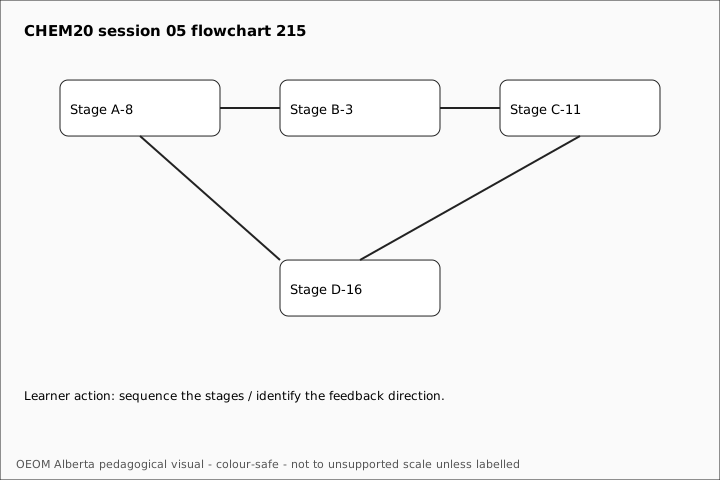
Visual task (BEFORE_LAB): Inspect the visual, notice labels, and answer the lesson prompt.
CHEM20 session 05 flowchart 215
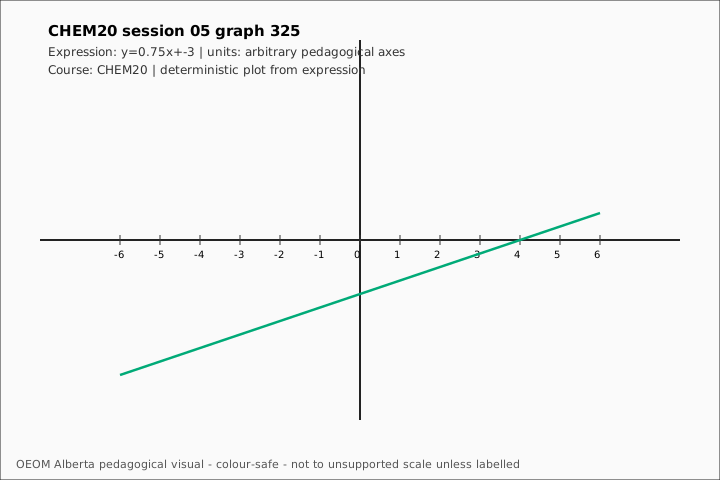
Visual task (BEFORE_LAB): Interpret the graph and state slope/intercept or trend.
CHEM20 session 05 graph 325