Chemistry 20
Alberta Chemistry 20 follows Units A–D. Canonical lessons cover the Program of Studies. The 10-session bootcamp is a separate accelerated pathway.
CHEM20 Session 04 — LOW-RESOURCE investigation: conductivity and solubility
Delivery id: CHEM20 (SCN2796)
Time: 75 minutes
Setting: CLASSROOM-SUPERVISED ONLY. Not a home lab. Not a demo-of-opportunity with random cupboard chemicals.
Unit A skills: 20-A1.1s, 20-A1.2s (and 20-A1.3s data analysis light)
Alberta POS: https://open.alberta.ca/publications/3950147-updated-2014
Hard bans: NO bleach. NO ammonia. NO flames. NO tasting. NO mixing of unknown cleaners. NO drain opener. NO hydrogen peroxide as a “conductor.” Vinegar is dilute acetic acid — goggles on; never combined with hypochlorite.
Official outcomes
| Code | Type | Role today |
|---|---|---|
| 20-A1.1s | Skill | Plan/ask: properties of ionic compounds (solubility, conductivity); WHMIS/consumer labels; safe handling |
| 20-A1.2s | Skill | Perform: conductivity/solubility of ionic vs molecular; record data; periodic-table bonding predictions |
| 20-A1.3s | Skill | Analyze: which samples behave as electrolytes |
| 20-A1.6k | Knowledge | Evidence link: lattice ions mobile in water vs molecular solute |
| 20-A1.1sts | STS | Everyday ionic vs molecular products (salt, sugar, vinegar) |
Melting point is not measured (no flames / no hot plates required). Use Session 03 data table if a student asks.
Learning targets
- Write a testable question and a hypothesis about conductivity and solubility of NaCl vs C12H22O11 vs CH3COOH(aq) (vinegar) vs distilled water.
- Collect mass, volume, qualitative solubility, and conductivity (LED brightness or meter reading) with SI units and a simple uncertainty (scale ±0.1 g or instrument half-division).
- Conclude: aqueous NaCl is a strong electrolyte; sucrose(aq) is a nonelectrolyte; vinegar is a weak electrolyte (partial ionization of a molecular acid — named honestly, not “failed salt”).
- Follow WHMIS, goggles, spill protocol, and the bleach/ammonia/flame/taste bans.
Prerequisites
Sessions 01–03. Safety contract signed. Goggles. Distilled water. Teacher-tested conductivity circuit (9 V + LED + resistors or school conductivity probe). Kitchen scale OK if calibrated against a known mass.
Diagnostic/retrieval
2 minutes, oral then paper:
- Does solid NaCl conduct?
- May you taste the white solids to “see which is sugar”?
- What ion does NaCl produce in water?
Teacher states answers before stations open: no; no; Na+(aq) and Cl−(aq).
Instruction
Question (class, then groups refine): How do solubility in water and electrical conductivity compare for table salt, table sugar, and white vinegar, using the same solvent mass/volume?
Chemistry to protect before data:
- \( \mathrm{NaCl}(s) \rightarrow \mathrm{Na}^{+}(aq) + \mathrm{Cl}^{-}(aq) \) (dissociation of an ionic lattice). Strong electrolyte.
- \( \mathrm{C}_{12}\mathrm{H}_{22}\mathrm{O}_{11}(s) \rightarrow \mathrm{C}_{12}\mathrm{H}_{22}\mathrm{O}_{11}(aq) \) (molecules disperse; no ions). Nonelectrolyte.
- Vinegar is ~5% \( \mathrm{CH}_{3}\mathrm{COOH}(aq) \). Acetic acid is molecular; a small fraction ionizes:
\( \mathrm{CH}_{3}\mathrm{COOH}(aq) + \mathrm{H}_{2}\mathrm{O}(\ell) \rightleftharpoons \mathrm{H}_{3}\mathrm{O}^{+}(aq) + \mathrm{CH}_{3}\mathrm{COO}^{-}(aq) \).
Weak electrolyte — dim LED, not “broken equipment.” Full acid theory is Unit C; today we name the observation.
- Distilled water: essentially no ions. Tap water may glow faintly (dissolved ions) — that is why distilled water is the control.
Variables:
Independent: identity of solute (and physical state: solid vs dissolved).
Dependent: solubility (visual + mass remaining if undissolved); conductivity (ordinal LED: none / dim / bright, or µS if a meter).
Controlled: water volume (e.g. 50.0 mL), solute mass (e.g. 2.0 g solids), temperature (room), same cups, same electrode spacing.
Not independent: mixing salt+sugar+vinegar into one cup “to save time.”
Timed visuals
| id | trigger | duration | alt | teacher cue | tutor cue |
|---|---|---|---|---|---|
| CHEM20-VIS-04-BAN | Door | 40 s | Four red stamps: BLEACH / AMMONIA / FLAME / TASTE | Point at each stamp | Refuse any banned procedure. |
| CHEM20-VIS-04-SETUP | Minute 8 | 60 s | Cup, 50 mL water, 2.0 g, electrodes 1 cm apart | “Same distance every trial.” | Do not redesign with new chemicals. |
| CHEM20-VIS-04-LED | Before data | 30 s | LED none / dim / bright | “Dim is data, not failure.” | Do not praise “vinegar failed.” |
Modelling/worked examples
Teacher models Trial 0 (distilled water) live.
- Mass empty cup (example) 4.2 g. Add 50.0 mL water ≈ 50.0 g if density taken as 1.00 g/mL at room temperature (state the assumption).
- Insert electrodes. LED off. Record “none.”
- Hypothesis sentence on the board: “If a solute produces mobile ions, then the LED will light; sucrose will not light; NaCl(aq) will; vinegar will light weakly.”
Worked calculation (mass fraction, optional CORE):
2.0 g NaCl in 50.0 g water → mass percent = \( \frac{2.0}{52.0}\times 100\% = 3.8\% \) (2 significant figures from 2.0 g).
Sample expected results (typical; groups must use their own data):
| Sample | Solubility in 50 mL water | Conductivity solid | Conductivity aqueous |
|---|---|---|---|
| Distilled H2O | n/a | n/a | none |
| NaCl | dissolves (2.0 g easily; solubility ~36 g / 100 mL at 20 °C) | none | bright |
| C12H22O11 | dissolves | none | none |
| Vinegar (already liquid) | miscible | n/a | dim |
| Tap water (optional extra) | n/a | n/a | dim |
If NaCl solid is tested with dry electrodes, LED stays off — lattice ions are not mobile.
Guided practice + answers
Groups complete the planner (question, hypothesis, variables, WHMIS for vinegar: corrosive/exclamation depending on concentration — 5% consumer vinegar is still goggles-on). Teacher stamps planners before chemicals.
Look-fors: distilled-water control; 2.0 g measured; no tasting; vinegar spill plan (water rinse, wipe); electrodes rinsed between trials.
Answers to planner items: see teacher-solutions.md Session 04.
Independent practice
During the lab, levels are analysis, not extra chemicals.
- FOUNDATION: Fill the data table. Write: NaCl(aq) conducts because ions; sugar does not because molecules.
- CORE: Include solid NaCl conductivity; mass percent of one solution; one error source (electrode spacing, tap-water contamination, undissolved solid). Write the NaCl dissociation equation.
- PROFICIENT: Explain vinegar’s dim LED with the ionization equilibrium (do not call vinegar ionic). Compare tap vs distilled if measured. State a limitation: LED is ordinal, not a concentration of ions.
- ADVANCED: Design on paper only a follow-up that varies NaCl mass (0.50 g, 1.0 g, 2.0 g) at fixed 50 mL to rank brightness — still classroom-supervised, still no new chemicals. Explain why melting point is absent from today’s data (safety: no flames). Connect to project: an ionic electrolyte is not automatically a safe cleaner.
Project connection
Evidence: water dissolves both ionic NaCl and molecular sucrose, so solubility alone does not identify bonding. Conductivity does (with the vinegar caveat). Milestone 1 will require bonding type + predicted conductivity.
Checks
Mid-lab freeze: “If the LED is bright in the sugar cup, what is the first troubleshooting step?” Expected: electrodes not rinsed (salt contamination), or wrong cup. Not: “sugar is ionic.”
Misconceptions
| Wrong | Repair | Do not say |
|---|---|---|
| “Sugar conducts because it dissolves.” | Dissolving ≠ ionization. | “Nice try.” |
| “Vinegar is ionic because it conducts.” | Molecular weak acid; few ions. | “Basically a salt.” |
| “The LED is broken on sugar.” | Nonelectrolyte is the result. | — |
| “We should add bleach to disinfect the cups.” | Forbidden. Soap and water after, teacher direction. | “Good hygiene idea.” |
| “Taste test confirms sugar.” | Prohibited. Identity is from the labelled bottle. | — |
AI Tutor prompts and boundaries
Allowed: “Write a hypothesis for NaCl vs sugar conductivity.” “What is the dissociation equation for NaCl?” “Why distilled water?”
Forbidden: Inventing labs; substituting bleach, ammonia, rubbing alcohol flames, microwave heating; “great job” if the student concludes sugar is ionic; giving a home version of this investigation; suggesting tasting.
Human-tutor handoff
IEP: teacher or EA handles electrodes; student records. Sensory: LED under a sleeve. If a student refuses chemicals: dataset alternative in CHEM20_SIMULATION_AND_DATASET_ALTERNATIVES.md (same questions, provided table). Spill on skin: rinse 15 min, teacher, SDS.
Exit ticket + answers
- Dissociation equation for NaCl(s) in water.
- Why sucrose(aq) does not light the LED.
- Why vinegar may light dimly.
- Name one substance that was banned today.
Answers: 1. \( \mathrm{NaCl}(s) \rightarrow \mathrm{Na}^{+}(aq)+\mathrm{Cl}^{-}(aq) \). 2. Dissolved molecules, no mobile ions. 3. Small fraction of CH3COOH ionizes, producing some H3O+ and CH3COO−. 4. Bleach or ammonia or flames or tasting (any one).
Homework
Finish the analysis questions. Graph is optional (bar chart of LED ordinal). No home replication. Photograph of the labelled school bottles is not required.
Teacher guidance
Pre-test the LED circuit with 2.0 g NaCl / 50 mL so “bright” is visible. Rinse protocol posted. Collect solids back; vinegar down the sink with water if municipal rules allow, else neutralize per school SDS. Do not send leftover vinegar home. Log any contamination of the sugar cup.
This investigation is not home-safe. Substitutes use EP01 paper dataset, not this protocol.
Materials
Per group: 4 clear cups; distilled water (500 mL); table salt NaCl; table sugar sucrose; white vinegar (5% acetic acid); kitchen or lab scale; measuring cup or graduated cylinder; 9 V conductivity tester or probe; goggles; paper towels; waste bowl; WHMIS sheet. Not provided: bleach, ammonia, matches, hot plates, food to eat.
Preparation
Night before: buy/confirm distilled water; test circuit; print data sheets; remove bleach from the room. Brief EA/sub: classroom-supervised only. Know eyewash location.
Timing
| Min | Move |
|---|---|
| 0–8 | Bans, retrieval, hypothesis |
| 8–15 | Teacher models distilled-water trial |
| 15–48 | Group trials + rinse discipline |
| 48–62 | Analysis by level |
| 62–70 | Board-share: sugar none / salt bright / vinegar dim |
| 70–75 | Exit + cleanup |
Online alternative
Not a kitchen lab. Use PhET *Sugar and Salt Solutions* (if approved) or the provided dataset in CHEM20_SIMULATION_AND_DATASET_ALTERNATIVES.md. Same analysis questions. Teacher still marks WHMIS items.
Low-technology alternative
If no LED: teacher-operated demo with one circuit at the front (still classroom, still bans). Students record from the demo and complete FOUNDATION/CORE writing. Paper ion vs molecule cards for the explanation.
Visual task (DURING_WORKED_EXAMPLE): Inspect the visual, notice labels, and answer the lesson prompt.
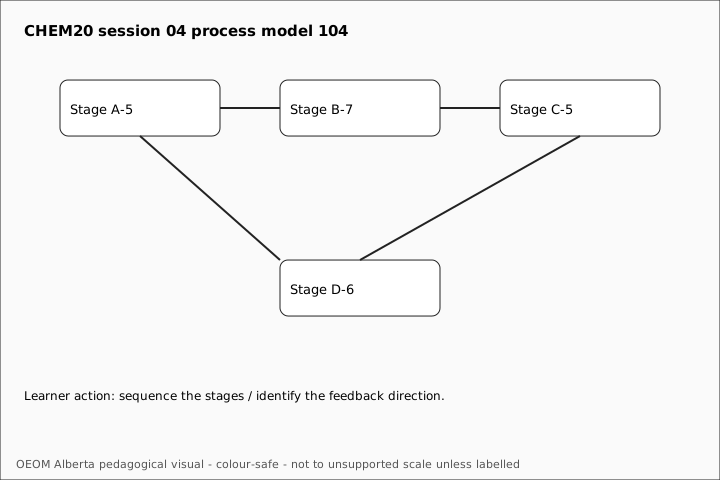
CHEM20 session 04 process model 104
Visual task (DURING_WORKED_EXAMPLE): Inspect the visual, notice labels, and answer the lesson prompt.
CHEM20 session 04 bonding model 214
Visual task (DURING_WORKED_EXAMPLE): Inspect the visual, notice labels, and answer the lesson prompt.
Open table abv-chem20-0324 - CHEM20 session 04 table 324
Open full table (lazy). Alt: CHEM20 session 04 table 324. Full instructional table for CHEM20.