Chemistry 20
Alberta Chemistry 20 follows Units A–D. Canonical lessons cover the Program of Studies. The 10-session bootcamp is a separate accelerated pathway.
CHEM20 Session 03 — Ionic bonding, electronegativity, lattices, properties
Delivery id: CHEM20 (SCN2796)
Time: 75 minutes
Unit A: Diversity of Matter and Chemical Bonding
Alberta POS: https://open.alberta.ca/publications/3950147-updated-2014
Official outcomes
| Code | Type | Role today |
|---|---|---|
| 20-A1.3k | Knowledge | Define valence electron, electronegativity, ionic bond, intramolecular force |
| 20-A1.4k | Knowledge | Use the periodic table and electron-dot diagrams to support ionic bonding theory |
| 20-A1.5k | Knowledge | Ionic bond as simultaneous attraction of oppositely charged ions |
| 20-A1.6k | Knowledge | Ionic lattices and properties: melting point, solubility, reactivity |
| 20-A1.2sts | STS | Electronegativity and relative bond strength / MP / BP (qualitative) |
Learning targets
- Draw Lewis (electron-dot) diagrams for Na, Cl, Na+, Cl−, Mg, O, Mg2+, O2− and show electron transfer for NaCl and MgO.
- State that an ionic bond is the simultaneous electrostatic attraction of each ion to all neighbouring opposite charges in a lattice, not a single Na–Cl pair.
- Link lattice to properties: high melting point, brittle, conducts when molten or aqueous, not as a solid; many (not all) dissolve in water.
- Use ΔEN as a guideline for ionic character and relate larger charge / smaller ion size qualitatively to stronger lattice (higher MP) without inventing numbers.
Prerequisites
Sessions 01–02 formulas. EN table from Session 01. No flames; melting-point data come from a table, not a Bunsen burner.
Diagnostic/retrieval
- Formula and name: compound of Al3+ and SO42−.
- ΔEN for NaCl (Cl 3.0, Na 0.9).
- How many valence electrons does oxygen have?
- True/false: solid NaCl conducts electricity.
Instruction
Electron-dot (Lewis) atoms. Na· (1 valence e). :Cl· with 7 dots. Transfer: Na loses 1 e → Na+ (no dots, or empty shell shown as [Na]+). Cl gains 1 e → [ :Cl: ]− with 8 dots. The resulting ions attract.
Simultaneous attraction (20-A1.5k). In the crystal, each Na+ is surrounded by six Cl− in rock salt (coordination 6:6). There is no isolated NaCl molecule in the solid. The intramolecular force in the compound is the ionic bonding throughout the lattice.
Lattice and properties (20-A1.6k).
| Property | Observation | Model |
|---|---|---|
| Melting point | NaCl(s) melts at 801 °C; MgO(s) at 2852 °C | Strong electrostatic lattice; MgO has 2+/2− vs 1+/1− |
| Electrical conductivity | Solid: none. Molten or aqueous: yes | Ions must be mobile; locked in solid lattice |
| Brittleness | Shifts and cleaves | Like charges align and repel when the lattice is displaced |
| Solubility | NaCl soluble in water; AgCl sparingly soluble | Water is polar (Session 09); solubility is compound-specific, not “all ionic salts dissolve” |
| Reactivity | Group 1 metals react vigorously with water — the metal, not the salt | Do not confuse Na(s) with NaCl(s) |
Electronegativity and bond strength (qualitative). Larger ΔEN → more ionic character (guideline). Higher ion charges and smaller internuclear distances → stronger lattice → typically higher MP. MgO vs NaCl is the worked contrast. Do not claim EN “causes” MP by itself; lattice energy depends on charge and size (Coulomb’s law: \( F \propto |q_{1}q_{2}|/r^{2} \)).
Reactivity reminder: Session 04 tests salts and molecular solutes, not alkali metals. No sodium metal. No flames.
Timed visuals
| id | trigger | duration | alt | teacher cue | tutor cue |
|---|---|---|---|---|---|
| CHEM20-VIS-03-TRANSFER | After retrieval | 70 s | Na· + ·Cl: → Na+ [:Cl:]− | “Electrons move. Nuclei do not.” | No “atoms want octets to be happy.” |
| CHEM20-VIS-03-LATTICE | Minute 18 | 80 s | 2-D NaCl grid, six neighbours labelled | “Every ion is bonded to all neighbours.” | Refuse “one ionic bond per formula.” |
| CHEM20-VIS-03-CONDUCT | Minute 30 | 50 s | Three panels: solid / molten / aqueous | “Mobile charges required.” | Do not invent a home conductivity lab; Session 04 is classroom only. |
| CHEM20-VIS-03-MP | Minute 38 | 40 s | Bar: NaCl 801 °C, MgO 2852 °C, H2O 0 °C | “Charge 2 and 2 vs 1 and 1.” | Quote table; do not heat MgO in class. |
Modelling/worked examples
Example 1 — Lewis transfer, NaCl.
Na· + ·Cl: → [Na]+ [ :Cl: ]−
ΔEN = 3.0 − 0.9 = 2.1 (ionic guideline). Formula unit NaCl. Lattice: 3-D.
Example 2 — MgO.
Mg has 2 valence e; O has 6. Mg loses 2 e → Mg2+; O gains 2 e → O2−.
ΔEN = 3.5 − 1.2 = 2.3. Formula MgO.
MP contrast: MgO 2852 °C vs NaCl 801 °C because |q+|·|q−| is 4 vs 1 (same order of ion size, qualitative).
Example 3 — Al2O3 Lewis (ratio only). Three O atoms accept 2 e each (6 e total); two Al atoms lose 3 e each (6 e total). Formula Al2O3. Do not draw a “molecule of Al2O3.”
Example 4 — conductivity prediction.
KBr(s): no. KBr(l) or KBr(aq): yes. C12H22O11(s) and (aq): no (molecular; Session 04/05). Preview only.
Example 5 — Coulomb estimate (PROFICIENT preview). If charge doubles on both ions, |q1q2| × 4; if distance similar, force roughly quadruples. This is a model, not a measured lattice energy.
Guided practice + answers
- Draw Lewis transfer for Li and F. Formula? Answer: LiF. Li· + ·F: → Li+ + [:F:]−.
- Why does solid NaCl not conduct? Answer: Ions are fixed in the lattice; no mobile charge carriers.
- Which has the higher expected MP, NaF or MgO? Answer: MgO (2+/2− vs 1+/1−). (Actual: MgO 2852 °C; NaF 993 °C.)
- A student says “NaCl is one ionic bond.” Repair. Answer: The formula unit is 1:1; the solid contains a lattice of many simultaneous attractions.
- AgCl is ionic but only very slightly soluble. Does that contradict 20-A1.6k? Answer: No. The outcome says structures relate to properties; solubility varies. “Ionic ⇒ always soluble” is false.
Independent practice
- FOUNDATION: Copy Lewis transfer for NaCl. Define valence electron, EN, ionic bond, intramolecular force. Predict: does solid NaCl conduct? Aqueous NaCl?
- CORE: Lewis for MgO and CaCl2 (show 2 Cl). Complete the property table for NaCl: MP high/low, solid conductivity, aqueous conductivity, brittle yes/no. ΔEN for KCl and classify by guideline.
- PROFICIENT: Explain MgO vs NaCl melting points using charge. Explain brittleness with a 4-ion sketch (++, −− repulsion after shift). Predict conductivity of CaCO3(s) vs a saturated CaCl2(aq) (CaCO3 is sparingly soluble — conductivity of a saturated solution is low; CaCl2(aq) is a strong electrolyte). No invented procedure.
- ADVANCED: Using Coulomb’s law qualitatively, rank lattice strength: NaCl, MgO, LiF (LiF MP 845 °C, NaCl 801 °C — size: Li+ smaller than Na+, so LiF slightly higher despite same charges). Write why EN alone does not rank MP. One STS sentence: semiconductors/ceramics are engineered lattices (20-A1.3sts light) — do not claim Chem 20 students will manufacture them.
Project connection
Water as a solvent for ionic cleaners/salts: polar water can hydrate ions (full mechanism Session 09). Record: ionic solids that dissolve and produce ions will conduct (Session 04 evidence). Do not select molten-salt processes for a household project.
Checks
Show of fingers: “How many Cl− around each Na+ in rock salt?” Six. If “one,” reteach lattice with the visual.
Misconceptions
| Wrong | Repair | Do not say |
|---|---|---|
| “Ionic compounds are molecules.” | Formula units in a lattice. | “Kind of like molecules.” |
| “Solid salt conducts because it has ions.” | Ions must be mobile. | “Good start.” |
| “All ionic compounds dissolve.” | AgCl, CaCO3, BaSO4 are classic counterexamples. | — |
| “High EN means high melting point.” | MP tracks lattice energy (charge, size), not EN of one element. | “Interesting.” |
| “NaCl(s) is dangerous like Na(s).” | Sodium metal reacts with water; table salt does not. | — |
AI Tutor prompts and boundaries
Allowed: “Draw NaCl Lewis transfer.” “Why is MgO’s melting point higher than NaCl’s?” “Why doesn’t solid KBr conduct?”
Forbidden: Home melting of salts; flame tests; “heat salt on the stove”; praising “NaCl molecule”; inventing AgCl as freely soluble; any bleach experiment to “test reactivity.”
Human-tutor handoff
If Lewis dots are messy: use ion-charge boxes instead of full dots for FOUNDATION, but CORE still needs Cl octet. If a learner pushes to “try melting salt at home,” stop; use the data table.
Exit ticket + answers
- Draw Lewis transfer for Ca and O (formula CaO).
- Why does NaCl(aq) conduct but NaCl(s) does not?
- Define intramolecular force as used in 20-A1.3k.
- Give one reason MgO melts higher than NaCl.
Answers: 1. Ca loses 2 e, O gains 2 e; Ca2+ O2−. 2. Mobile ions in solution; fixed ions in the crystal. 3. Force within the compound holding it together (here, ionic bonding in the lattice). 4. 2+ and 2− vs 1+ and 1− (stronger electrostatic attraction).
Homework
Complete the property table for K2O vs CaO using charge reasoning (no need for looked-up MP unless provided). Read Session 04 safety sheet. Consent/safety form if the school requires it for the investigation.
Teacher guidance
Do not light a burner to “show melting.” Use the published MP table. Kill “all salts dissolve” before Session 04 so sugar vs salt is about conductivity, not “which one disappears.”
Materials
EN table; Lewis-dot stamps or stickers; NaCl lattice model or printed grid; MP data card (NaCl 801 °C, MgO 2852 °C, LiF 845 °C, NaF 993 °C, H2O 0 °C); conductivity cartoon panels.
Preparation
Remove any leftover alkali metals from demo drawers if a previous class used them. Print Session 04 materials list for tomorrow. Confirm distilled water order for Session 04.
Timing
| Min | Move |
|---|---|
| 0–6 | Retrieval |
| 6–20 | Lewis transfer + simultaneous attraction |
| 20–38 | Lattice properties + MP data |
| 38–50 | Guided |
| 50–66 | Independent |
| 66–75 | Exit + Session 04 safety preview |
Online alternative
PhET or equivalent crystal viewer if school-approved; otherwise static lattice PNG. MP dataset CSV. No “microwave the salt” instructions.
Low-technology alternative
Paper squares Na+ / Cl− taped into a grid. Slide the paper to show like charges lining up (brittle). Conductivity taught from the three-panel drawing.
Visual task (BEFORE_WORKED_EXAMPLE): Inspect the visual, notice labels, and answer the lesson prompt.
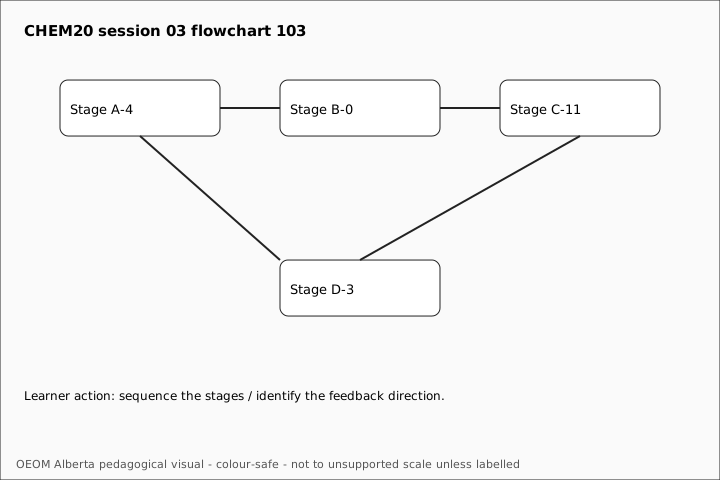
CHEM20 session 03 flowchart 103
Visual task (BEFORE_WORKED_EXAMPLE): Interpret the graph and state slope/intercept or trend.
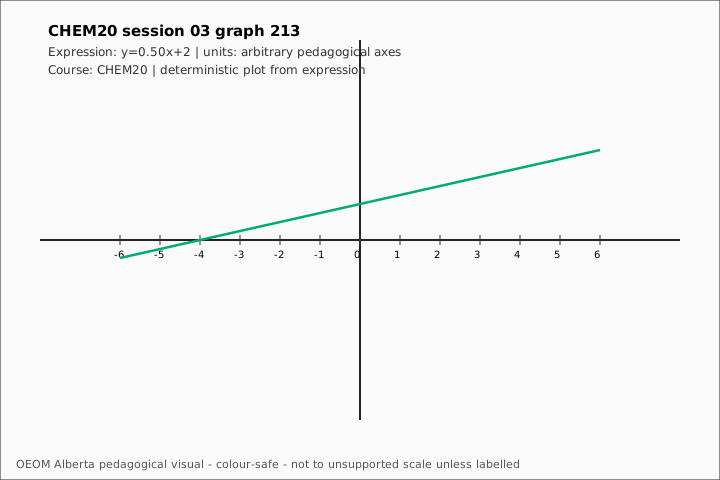
CHEM20 session 03 graph 213
Visual task (BEFORE_WORKED_EXAMPLE): Inspect the visual, notice labels, and answer the lesson prompt.
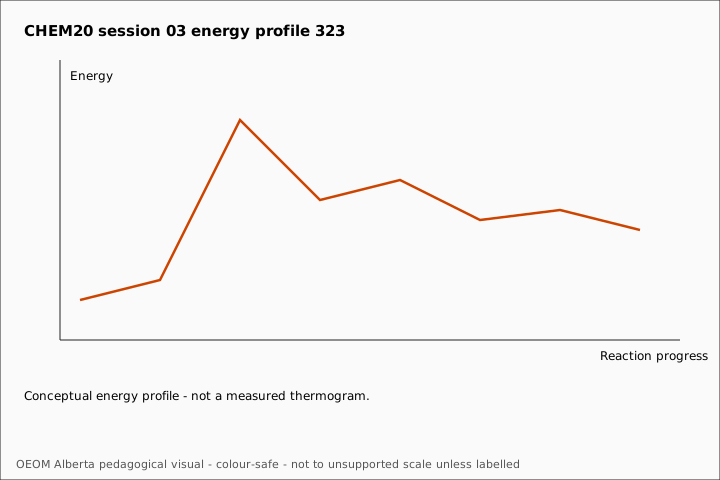
CHEM20 session 03 energy profile 323