Chemistry 20
Alberta Chemistry 20 follows Units A–D. Canonical lessons cover the Program of Studies. The 10-session bootcamp is a separate accelerated pathway.
CHEM20 Session 01 — Diagnostic, Science 10 retrieval, safety/WHMIS
Delivery id: CHEM20 (PASI SCN2796, 5 credits)
Time: 75 minutes
Unit A: Diversity of Matter and Chemical Bonding
Alberta POS: Chemistry 20 (2007, updated 2014) — https://open.alberta.ca/publications/3950147-updated-2014
Umbrella project (named today, not due): Safe water / cleaning chemistry — material selection for a household-safe water or hygiene micro-enterprise.
AI Tutor: official Chemistry 20 profile only. Must not invent labs. Must not praise incorrect chemistry.
Official outcomes
| Code | Type | Role today |
|---|---|---|
| 20-A1.1k | Knowledge | Intro: recall principles for assigning names to ionic compounds (binary, Science 10 depth + Chem 20 restart) |
| 20-A1.3k | Knowledge | Intro: define valence electron, electronegativity, ionic bond, intramolecular force |
| 20-A1.1s | Skill | WHMIS / consumer-label safe handling (IP–NS4 fragment) |
| Science 10 retrieval | Prerequisite | Atoms, ions, Bohr models, metal/non-metal, simple binary ionic names |
Not today: polyatomic ions as a full system (Session 02); lattices (Session 03); Session 04 investigation.
Learning targets
- State the difference between an atom, a cation, and an anion using proton/electron counts.
- Name and write formulas for binary ionic compounds of Group 1/2 metals with Group 16/17 non-metals (e.g. NaCl, MgO, CaBr2, Al2O3).
- Define valence electron, electronegativity, ionic bond, and intramolecular force in Chem 20 language.
- Identify WHMIS 2015 pictograms on a salt, vinegar, and a fictional cleaner SDS excerpt; state the bleach+acid and bleach+ammonia prohibitions.
Prerequisites
Science 10 Unit A (atoms, ions, ionic vs molecular, simple naming). If a learner missed Science 10, stay on FOUNDATION trays; do not skip WHMIS.
Diagnostic/retrieval
Silent, 8 minutes, paper. No talking. Score as baseline, not mastery.
- Number of protons and electrons in \( \mathrm{Na} \), \( \mathrm{Na}^{+} \), \( \mathrm{Cl} \), \( \mathrm{Cl}^{-} \). (Na Z = 11; Cl Z = 17.)
- Name \( \mathrm{MgO} \) and \( \mathrm{CaCl}_{2} \). Write the formula for potassium sulfide.
- Circle the valence electrons on a Bohr diagram of \( \mathrm{O} \) (8 p, 8 e: 2, 6).
- True/false: “You may taste a white powder in chemistry class if it looks like sugar.”
- Name one WHMIS pictogram you recognize.
Instruction
Atom vs ion. Sodium atom: 11 p, 11 e, net charge 0. Sodium ion: 11 p, 10 e, charge \( +1 \). Chlorine atom: 17 p, 17 e. Chloride ion: 17 p, 18 e, charge \( -1 \). Ions form when electrons transfer; the nucleus (protons) does not change.
Valence electrons are the electrons in the highest occupied energy level. They determine bonding. Na: \( 1s^{2}2s^{2}2p^{6}3s^{1} \) → 1 valence electron. Cl: \( 3s^{2}3p^{5} \) → 7 valence electrons. (Bohr: Na 2,8,1; Cl 2,8,7.)
Electronegativity (EN) is the relative ability of an atom in a bond to attract bonding electrons. Pauling values used in this pack (Alberta Chem 20 data-sheet convention): F 4.0, O 3.5, N 3.0, Cl 3.0, Br 2.8, C 2.5, S 2.5, H 2.1, Na 0.9, K 0.8, Mg 1.2, Ca 1.0, Al 1.5. ΔEN is a guideline, not a law: ΔEN ≳ 1.7 often ionic; 0.5–1.7 polar covalent; < 0.5 nonpolar covalent. \( \mathrm{HF} \) (ΔEN = 1.9) is still a covalent molecule — flag this for Session 09.
Ionic bond: electrostatic attraction between oppositely charged ions after electron transfer. Intramolecular force: force within a compound holding it together (ionic, covalent, metallic). Intermolecular forces wait until Session 08.
Naming restart (binary ionic): metal name + non-metal stem + -ide. \( \mathrm{NaCl} \) sodium chloride, not “chlorine sodium.” Formula is the simplest ratio that gives net charge zero: \( \mathrm{Na}^{+} \) and \( \mathrm{Cl}^{-} \) → \( \mathrm{NaCl} \); \( \mathrm{Al}^{3+} \) and \( \mathrm{O}^{2-} \) → \( \mathrm{Al}_{2}\mathrm{O}_{3} \).
WHMIS 2015 (GHS-aligned). Pictograms: flame, flame over circle (oxidizer), gas cylinder, corrosion, exploding bomb, skull and crossbones, health hazard, exclamation mark, environment. Consumer labels (HHPS) still appear on household products. Hard bans for this course: never mix bleach (NaClO) with acid (including vinegar, \( \mathrm{CH}_{3}\mathrm{COOH} \)) — chlorine gas. Never mix bleach with ammonia — chloramines. No flames. No tasting. No unsupervised home labs. Session 04 is classroom-supervised only.
Timed visuals
| id | trigger | duration | alt | teacher cue | tutor cue |
|---|---|---|---|---|---|
| CHEM20-VIS-01-IONS | After Q1 diagnostic | 70 s | Na atom vs Na+; Cl vs Cl− with p/e counts | “Protons stay. Electrons change.” | Recite counts; do not say “sodium wants to be happy.” |
| CHEM20-VIS-01-EN | Minute 18 | 50 s | EN map: F 4.0 left-right increase, bottom-top increase | Point to F and Cs | Quote table values; no invented EN numbers. |
| CHEM20-VIS-01-WHMIS | Minute 28 | 80 s | Nine WHMIS 2015 pictograms + bleach/acid crossed out | “Vinegar is an acid. Bleach is never in this room.” | Repeat bans; refuse any mixing procedure. |
| CHEM20-VIS-01-LATTICE-TEASE | Minute 40 | 40 s | NaCl lattice still (label Session 03) | “Bond is between all neighbours, not one pair.” | Do not teach full lattice yet. |
Modelling/worked examples
Example 1 — ions. Write the ion formed by magnesium and by oxygen, then the compound.
- Mg: Group 2, 12 p, 12 e → loses 2 e → \( \mathrm{Mg}^{2+} \) (12 p, 10 e).
- O: Group 16, 8 p, 8 e → gains 2 e → \( \mathrm{O}^{2-} \) (8 p, 10 e).
- Charges \( +2 \) and \( -2 \) already cancel in 1:1 ratio → \( \mathrm{MgO} \), magnesium oxide.
- ΔEN: \( 3.5 - 1.2 = 2.3 \) → ionic by the 1.7 guideline.
Example 2 — formula from charges. Aluminum and bromine.
- \( \mathrm{Al}^{3+} \), \( \mathrm{Br}^{-} \). Least common multiple of 3 and 1 is 3: one Al, three Br → \( \mathrm{AlBr}_{3} \), aluminum bromide.
- Check: \( (+3) + 3(-1) = 0 \).
Example 3 — name to formula. Calcium nitride.
- Ca Group 2 → \( \mathrm{Ca}^{2+} \). Nitride is \( \mathrm{N}^{3-} \). LCM of 2 and 3 is 6: three \( \mathrm{Ca}^{2+} \), two \( \mathrm{N}^{3-} \) → \( \mathrm{Ca}_{3}\mathrm{N}_{2} \).
- Check: \( 3(+2) + 2(-3) = 0 \).
Non-example (kill it): “NaCl2 because chlorine is diatomic.” Chlorine gas is \( \mathrm{Cl}_{2} \); chloride in a salt is \( \mathrm{Cl}^{-} \). Formula is \( \mathrm{NaCl} \).
Guided practice + answers
- Protons and electrons in \( \mathrm{K}^{+} \) (K, Z = 19) and \( \mathrm{S}^{2-} \) (S, Z = 16).
Answers: \( \mathrm{K}^{+} \): 19 p, 18 e. \( \mathrm{S}^{2-} \): 16 p, 18 e.
- Name \( \mathrm{Li}_{2}\mathrm{O} \) and \( \mathrm{BaF}_{2} \). Formula for aluminum sulfide.
Answers: lithium oxide; barium fluoride; \( \mathrm{Al}_{2}\mathrm{S}_{3} \).
- How many valence electrons does \( \mathrm{N} \) have? Write the ionic compound of Na and N.
Answers: 5 valence electrons; \( \mathrm{Na}_{3}\mathrm{N} \), sodium nitride.
- A bottle shows the corrosion pictogram and “acetic acid 5%.” May you mix it with household bleach to “clean better”?
Answer: No. Acid + hypochlorite produces chlorine gas. Ban is absolute.
Independent practice
- FOUNDATION: Complete the table: atom/ion, p, e, charge for Li, Li+, O, O2−. Name NaBr and write formula for magnesium chloride.
- CORE: Write formulas: potassium oxide, calcium iodide, aluminum oxide. Name \( \mathrm{SrS} \) and \( \mathrm{GaCl}_{3} \). Define valence electron and ionic bond in one sentence each.
- PROFICIENT: Predict formulas and names for the compounds of Mg with N, and of Al with S. Compute ΔEN for NaCl and for HCl using the pack table; classify each as ionic or polar covalent by the guideline, and write one sentence on why HCl is still a molecule.
- ADVANCED: A student writes \( \mathrm{Na}_{2}\mathrm{Cl} \) because “sodium is diatomic in some charts.” Write the correct formula, the charge-balance check, and a two-sentence explanation of intramolecular force in \( \mathrm{NaCl}(s) \) (electrostatic lattice, not a Na–Cl molecule). Flag one WHMIS issue on a fictional SDS that lists “mix with bleach for extra strength.”
Project connection
Name the umbrella project: Safe water / cleaning chemistry. Today’s only deliverable is a one-line notebook entry: “I will not select bleach+acid or bleach+ammonia systems.” Material selection brief is Session 10.
Checks
Mini-whiteboard: show formula for calcium oxide. Expected \( \mathrm{CaO} \). If \( \mathrm{CaO}_{2} \) appears, stop and reteach peroxide vs oxide (\( \mathrm{O}_{2}^{2-} \) vs \( \mathrm{O}^{2-} \)) in one sentence: peroxide is not today; oxide is \( \mathrm{O}^{2-} \).
Misconceptions
| Wrong | Repair | Do not say |
|---|---|---|
| “NaCl is a molecule of one Na and one Cl.” | Formula unit of a lattice; 1:1 ratio, not a discrete molecule. | “Close enough.” |
| “You can taste chemicals if they are food-grade.” | Lab tasting is forbidden. Food-grade still follows WHMIS in this room. | “Smart thinking.” |
| “Chlorine in salt is Cl2.” | Elemental chlorine is Cl2(g); the ion is Cl−. | “Good connection.” |
| “Metals gain electrons.” | Metals typically lose electrons to form cations. | “Interesting idea.” |
| “WHMIS is only for factories.” | WHMIS and consumer labels apply to school chemicals and household products. | — |
| “Mixing cleaners is advanced chemistry.” | Bleach+acid and bleach+ammonia are prohibited, not enrichment. | “Creative.” |
Never praise the wrong idea. Name the error, give the correct model, move on.
AI Tutor prompts and boundaries
Allowed: “How many electrons in Ca2+?” “Name MgCl2.” “Define electronegativity using the class table.” “What does the corrosion pictogram mean?”
Forbidden: Inventing labs; home procedures with bleach, ammonia, drain cleaner, or flames; “great job” when the formula is wrong; claiming ΔEN is a physical law; storing student SDS photos with home addresses.
If the student asks how to mix bleach and vinegar: refuse; state chlorine-gas hazard; tell them to stop and tell the teacher. No alternative mixing recipe.
Human-tutor handoff
- Missing Science 10: FOUNDATION table + ion flashcards; do not start polyatomics.
- ELL: allow ion-charge chart as open note today; still require English names on the exit ticket.
- Safety refusal / anxiety: written WHMIS matching only; no pressure to handle bottles.
- Crisis / chemical exposure language at home: stop academic chat; teacher + school protocol; poison control 1-844-POISON-X (Alberta) / 1-844-764-7669 if exposure is occurring.
Exit ticket + answers
- Electrons in \( \mathrm{Al}^{3+} \) (Al, Z = 13)?
- Formula and name: compound of \( \mathrm{Ca}^{2+} \) and \( \mathrm{F}^{-} \).
- Define ionic bond in one sentence.
- True/false: bleach and vinegar may be mixed in the project.
Answers: 1. 10 electrons. 2. \( \mathrm{CaF}_{2} \), calcium fluoride. 3. Electrostatic attraction between oppositely charged ions (intramolecular in the ionic compound). 4. False.
Homework
Read the ion-charge chart (Groups 1, 2, 13, 15–17). Write ten binary ionic formulas from names on the sheet. Optional: photograph a consumer WHMIS/HHPS label on a product already in the home (no opening, no mixing). Do not buy chemicals. Do not handle bleach for homework.
Teacher guidance
Collect diagnostics into a baseline file; do not tick 20-A1.1k complete. Post the bleach/acid/ammonia ban where Session 04 stations will sit. If a student discloses they already mix cleaners at a job, treat as a safety conversation, not a confession to grade.
Materials
Periodic tables with EN values; Bohr-diagram blanks; WHMIS 2015 poster; fictional SDS excerpt (acetic acid 5%); ion-charge chart; baseline diagnostic slips.
Preparation
Print diagnostics. Confirm no bleach or ammonia is in the Chem 20 cupboard for weeks 1–2. Know the school chemical-spill and poison-control numbers. Seat learners who need FOUNDATION near the ion chart.
Timing
| Min | Move |
|---|---|
| 0–8 | Diagnostic / Science 10 retrieval |
| 8–22 | Atoms/ions, valence, EN, ionic bond, intramolecular |
| 22–32 | WHMIS 2015 + hard bans |
| 32–48 | Worked formulas + guided practice |
| 48–65 | Independent levels |
| 65–75 | Exit ticket + homework + project named |
Online alternative
Same diagnostic in LMS (locked after 8 min). WHMIS matching with still images. Camera-off permitted. No kitchen “try this at home” prompt. Simulation allowed: periodic-table EN lookup only.
Low-technology alternative
Board: p/e counts and three worked formulas. Paper WHMIS cards. No slideshow required. Ban written in block letters.
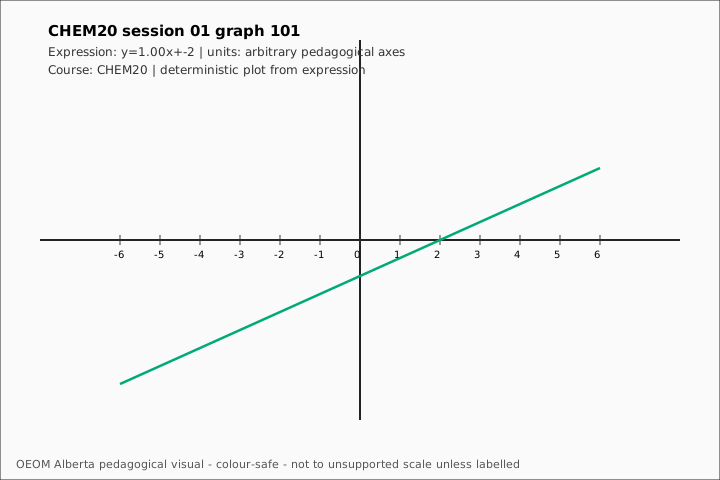
Visual task (AFTER_RETRIEVAL): Interpret the graph and state slope/intercept or trend.
CHEM20 session 01 graph 101
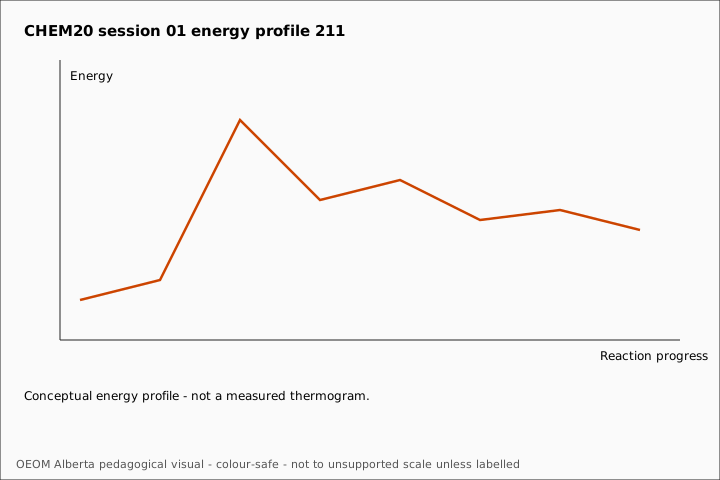
Visual task (AFTER_RETRIEVAL): Inspect the visual, notice labels, and answer the lesson prompt.
CHEM20 session 01 energy profile 211
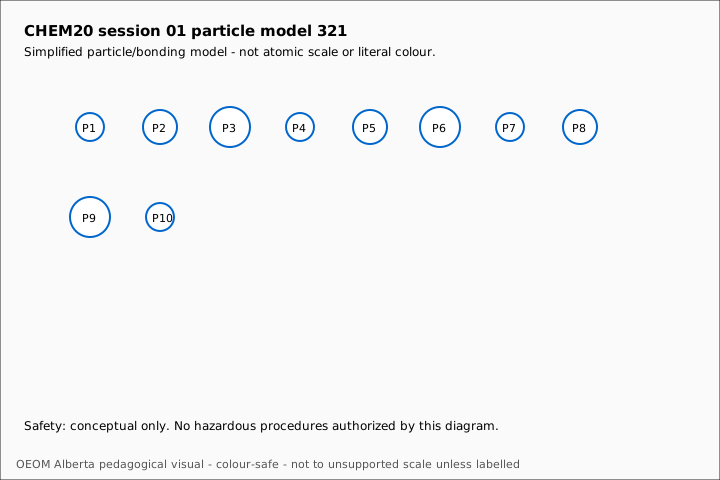
Visual task (AFTER_RETRIEVAL): Compare particle arrangements before predicting a property.
CHEM20 session 01 particle model 321