Chemistry 20 - Plan titration or crystallization analysis
LESSON = canonical instructional unit covering official Chemistry 20 outcomes. SESSION = bootcamp delivery event. A bootcamp session may overlay several Unit A lessons.
Canonical lesson CHEMISTRY20-U4-L20 · outcome 20-D2.1s · depth CURRICULUM_BASELINE
Unit D: Quantitative Relationships in Chemical Changes - outcome 20-D2.1s
- Course: CHEMISTRY20 (SCN2796)
- Lesson ID:
CHEMISTRY20-U4-L20 - Official outcome:
20-D2.1s(SKILL) - Object type: canonical lesson (not a bootcamp session)
- Source: Alberta Chemistry 20 Program of Studies (2007, updated 2014)
Official outcome text
formulate questions about observed relationships and plan investigations of questions, ideas, problems and issues • design a procedure, using crystallization, filtration or titration, to determine the concentration of a solution (IP-ST2) • describe procedures for the safe handling, storage and disposal of materials used in the laboratory, with reference to WHMIS and consumer product labelling information (IP-ST3) • predict the approximate equivalence point for a strong monoprotic acid-strong monoprotic base titration and select an appropriate indicator (IP-NS3, IP-NS4)
Learning intention
Meet 20-D2.1s with instruction, practice, and a check. The 10-session bootcamp does not replace this lesson.
Success criteria
- Restate the outcome in classroom language without swapping in a different unit’s template.
- Complete the worked-style task for this outcome.
- Name the lab setting (classroom-supervised / teacher demo / dataset or simulation / forbidden).
Teaching
Design crystallization, filtration, or strong-strong titration to find concentration; choose indicator; WHMIS; predict approximate equivalence.
Worked example
Plan: 25.0 mL of unknown monoprotic strong acid titrated with 0.100 mol/L NaOH; phenolphthalein; equivalence ~ if c unknown then V_b varies - predict using a trial value on the card. Alternative: dataset titration curve.
Guided practice
- Write full titration plan with indicator justification.
- Near-miss: weak acid treated with strong-strong assumptions without note. Flag it.
Independent practice
- Crystallization/filtration alternative plan for a soluble salt concentration.
- WHMIS and disposal.
- Dataset alternative named.
Diagram / whiteboard
Approved diagram id chem20-stoich-mole-map - Mole map stoichiometry flow. Tutor may open the course whiteboard and display this id. Do not invent hazardous procedures on the board.
Checks for understanding
Use the formative evidence below as the exit check for this outcome. Correct the misconception named in this lesson before praising.
Misconception to repair
Home burette with drain cleaner.
Safety and lab register
Setting: School titration or dataset. No home acids/bases. AI Tutor must not invent labs outside CHEM20_LOW_RESOURCE_LAB_REGISTER.csv.
Alberta Poison Control if a real exposure is occurring: 1-844-764-7669. The AI Tutor is not a poison centre.
Formative evidence
Titration or crystallization plan with equivalence prediction.
This is not a diploma. Mastery needs instruction + activity + check.
AI Tutor / human tutor
Ground on 20-D2.1s. No false praise. No invented procedures. No silent skip to a different unit. Human tutor if the student describes mixing bleach, tasting, or flames.
Provenance
Official POS wording from ALBERTA_SENIOR_HIGH_OFFICIAL_OUTCOMES.csv. Pack lesson written to replace Wave-4 contaminated canonical markdown.
Visual task (AFTER_PRACTICE): Compare particle arrangements before predicting a property.
CHEM20 CHEMISTRY20 U4 L20 particle model 097
Visual task (AFTER_PRACTICE): Inspect the visual, notice labels, and answer the lesson prompt.
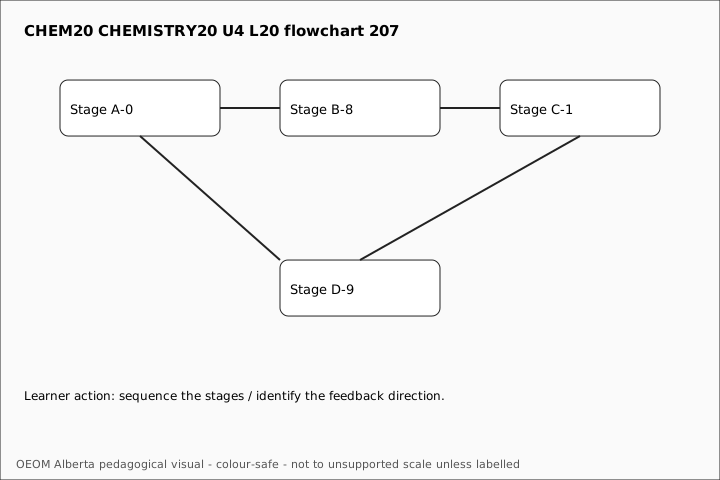
CHEM20 CHEMISTRY20 U4 L20 flowchart 207
Visual task (AFTER_PRACTICE): Interpret the graph and state slope/intercept or trend.
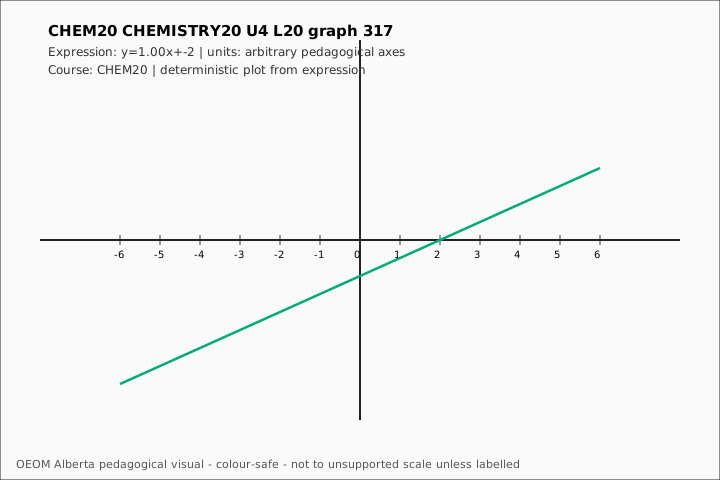
CHEM20 CHEMISTRY20 U4 L20 graph 317