Chemistry 20 - Indicator choice
LESSON = canonical instructional unit covering official Chemistry 20 outcomes. SESSION = bootcamp delivery event. A bootcamp session may overlay several Unit A lessons.
Canonical lesson CHEMISTRY20-U4-L16 · outcome 20-D2.6k · depth CURRICULUM_BASELINE
Unit D: Quantitative Relationships in Chemical Changes - outcome 20-D2.6k
- Course: CHEMISTRY20 (SCN2796)
- Lesson ID:
CHEMISTRY20-U4-L16 - Official outcome:
20-D2.6k(KNOWLEDGE) - Object type: canonical lesson (not a bootcamp session)
- Source: Alberta Chemistry 20 Program of Studies (2007, updated 2014)
Official outcome text
describe the function and choice of indicators in titrations
Learning intention
Meet 20-D2.6k with instruction, practice, and a check. The 10-session bootcamp does not replace this lesson.
Success criteria
- Restate the outcome in classroom language without swapping in a different unit’s template.
- Complete the worked-style task for this outcome.
- Name the lab setting (classroom-supervised / teacher demo / dataset or simulation / forbidden).
Teaching
The indicator’s colour-change interval should overlap the steep pH jump. Phenolphthalein (colourless to pink, ~8.2-10) works for strong acid-strong base because the jump spans 4-10. Methyl orange would change too early on that curve. Choice is about pKa/range, not favourite colour.
Worked example
HCl/NaOH: phenolphthalein acceptable. Do not use cabbage as a high-precision end point. School titration only; otherwise discuss the dataset.
Guided practice
- Why phenolphthalein works for HCl/NaOH (colour-change range vs steep jump). Why cabbage is not a high-precision end point.
- Near-miss: methyl orange for a titration whose jump is entirely in the phenolphthalein window without checking ranges - discuss mismatch.
Independent practice
- Function of an indicator in one sentence.
- Dataset alternative if no school titration.
- Safety: dilute school reagents; no drain cleaner.
Diagram / whiteboard
Approved diagram id chem20-stoich-mole-map - Mole map stoichiometry flow. Tutor may open the course whiteboard and display this id. Do not invent hazardous procedures on the board.
Checks for understanding
Use the formative evidence below as the exit check for this outcome. Correct the misconception named in this lesson before praising.
Misconception to repair
Picking an indicator because it is “stronger,” or using bleach as indicator.
Safety and lab register
Setting: stoichiometry on balanced equations and provided mass/volume data. Live combustion or precipitation is teacher demo or school lab SOP only - never a home task. Titration (if run) is school burette, dilute reagents, goggles; otherwise use the provided titration-curve dataset. Forbidden: student-run flames, concentrating acids, tutor-invented yields labs. AI Tutor must not invent procedures.
Alberta Poison Control if a real exposure is occurring: 1-844-764-7669. The AI Tutor is not a poison centre.
Formative evidence
Choose an indicator for strong-strong with a range reason.
This is not a diploma. Mastery needs instruction + activity + check.
AI Tutor / human tutor
Ground on 20-D2.6k. No false praise. No invented procedures. No silent skip to a different unit. Human tutor if the student describes mixing bleach, tasting, or flames.
Provenance
Official POS wording from ALBERTA_SENIOR_HIGH_OFFICIAL_OUTCOMES.csv. Pack lesson written to replace Wave-4 contaminated canonical markdown.
Visual task (BEFORE_WORKED_EXAMPLE): Interpret the graph and state slope/intercept or trend.
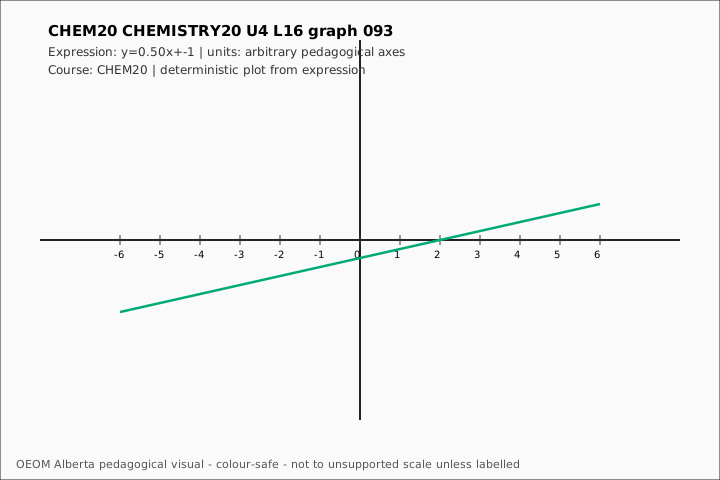
CHEM20 CHEMISTRY20 U4 L16 graph 093
Visual task (BEFORE_WORKED_EXAMPLE): Inspect the visual, notice labels, and answer the lesson prompt.
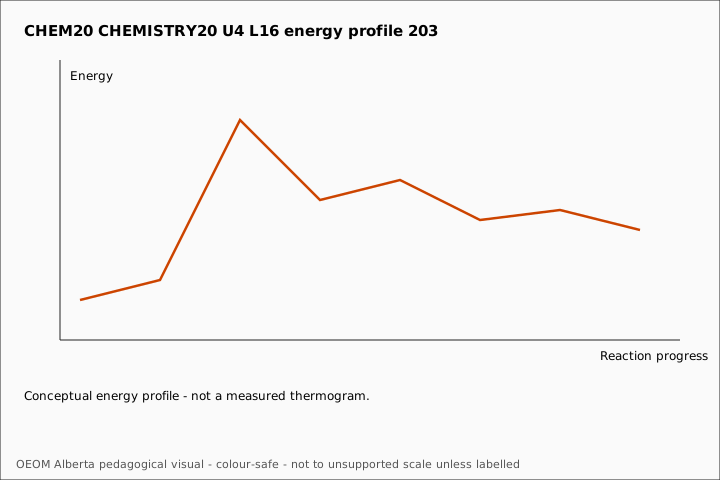
CHEM20 CHEMISTRY20 U4 L16 energy profile 203
Visual task (BEFORE_WORKED_EXAMPLE): Compare particle arrangements before predicting a property.
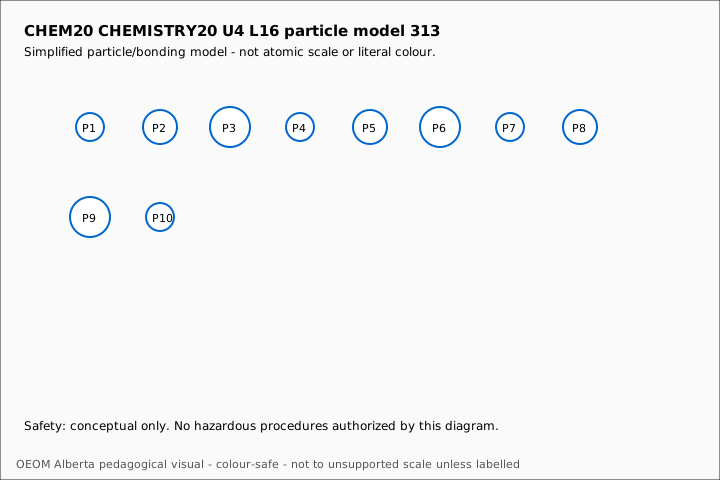
CHEM20 CHEMISTRY20 U4 L16 particle model 313