Chemistry 20 - Theoretical vs actual yield
LESSON = canonical instructional unit covering official Chemistry 20 outcomes. SESSION = bootcamp delivery event. A bootcamp session may overlay several Unit A lessons.
Canonical lesson CHEMISTRY20-U4-L13 · outcome 20-D2.3k · depth CURRICULUM_BASELINE
Unit D: Quantitative Relationships in Chemical Changes - outcome 20-D2.3k
- Course: CHEMISTRY20 (SCN2796)
- Lesson ID:
CHEMISTRY20-U4-L13 - Official outcome:
20-D2.3k(KNOWLEDGE) - Object type: canonical lesson (not a bootcamp session)
- Source: Alberta Chemistry 20 Program of Studies (2007, updated 2014)
Official outcome text
define theoretical yields and actual yields
Learning intention
Meet 20-D2.3k with instruction, practice, and a check. The 10-session bootcamp does not replace this lesson.
Success criteria
- Restate the outcome in classroom language without swapping in a different unit’s template.
- Complete the worked-style task for this outcome.
- Name the lab setting (classroom-supervised / teacher demo / dataset or simulation / forbidden).
Teaching
Theoretical yield is the mass (or moles) of product predicted from stoichiometry using the limiting reagent, assuming complete conversion and no loss. Actual yield is what is obtained in the experiment (given data). Actual is usually less than theoretical.
Worked example
If theory says 12.0 g AgCl and the filter paper holds 10.8 g AgCl, actual = 10.8 g, theoretical = 12.0 g.
Guided practice
- Theory 18.0 g; actual 15.3 g. Identify each quantity. Do not copy 12.0/10.8 only.
- Near-miss: calling 15.3 g the theoretical because it was “measured.” Mark it.
Independent practice
- If actual > theoretical, what experimental error is likely (wet product)?
- Two sentences: definitions.
- Where percent yield will be computed next lesson.
Diagram / whiteboard
Approved diagram id chem20-stoich-mole-map - Mole map stoichiometry flow. Tutor may open the course whiteboard and display this id. Do not invent hazardous procedures on the board.
Checks for understanding
Use the formative evidence below as the exit check for this outcome. Correct the misconception named in this lesson before praising.
Misconception to repair
Calling the leftover excess reactant “actual yield.”
Safety and lab register
Setting: stoichiometry on balanced equations and provided mass/volume data. Live combustion or precipitation is teacher demo or school lab SOP only - never a home task. Titration (if run) is school burette, dilute reagents, goggles; otherwise use the provided titration-curve dataset. Forbidden: student-run flames, concentrating acids, tutor-invented yields labs. AI Tutor must not invent procedures.
Alberta Poison Control if a real exposure is occurring: 1-844-764-7669. The AI Tutor is not a poison centre.
Formative evidence
Label actual vs theoretical on a filter-paper scenario.
This is not a diploma. Mastery needs instruction + activity + check.
AI Tutor / human tutor
Ground on 20-D2.3k. No false praise. No invented procedures. No silent skip to a different unit. Human tutor if the student describes mixing bleach, tasting, or flames.
Provenance
Official POS wording from ALBERTA_SENIOR_HIGH_OFFICIAL_OUTCOMES.csv. Pack lesson written to replace Wave-4 contaminated canonical markdown.
Visual task (REMEDIATION_ONLY): Match apparatus parts to the procedure steps (simulation/demo only).
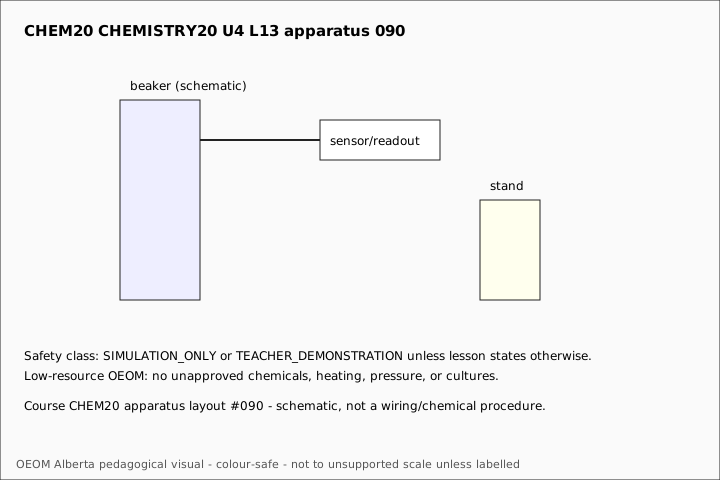
CHEM20 CHEMISTRY20 U4 L13 apparatus 090
Visual task (REMEDIATION_ONLY): Inspect the visual, notice labels, and answer the lesson prompt.
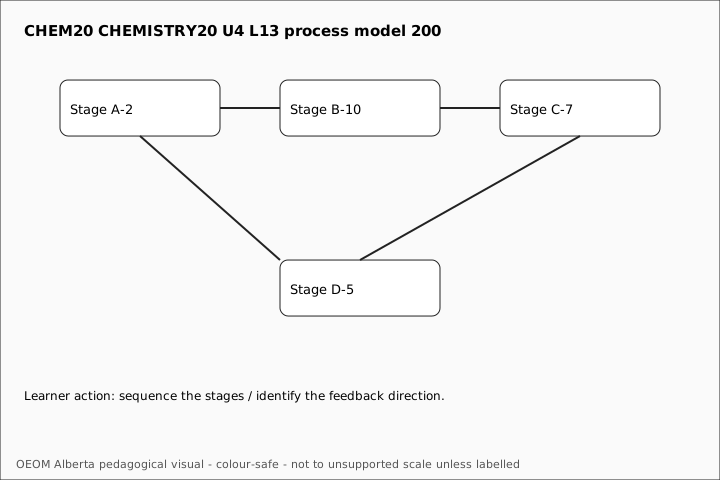
CHEM20 CHEMISTRY20 U4 L13 process model 200
Visual task (REMEDIATION_ONLY): Inspect the visual, notice labels, and answer the lesson prompt.
CHEM20 CHEMISTRY20 U4 L13 bonding model 310