Chemistry 20 - Plan acid-base classification
LESSON = canonical instructional unit covering official Chemistry 20 outcomes. SESSION = bootcamp delivery event. A bootcamp session may overlay several Unit A lessons.
Canonical lesson CHEMISTRY20-U3-L34 · outcome 20-C2.1s · depth CURRICULUM_BASELINE
Unit C: Solutions, Acids, Bases and Equilibrium intro - outcome 20-C2.1s
- Course: CHEMISTRY20 (SCN2796)
- Lesson ID:
CHEMISTRY20-U3-L34 - Official outcome:
20-C2.1s(SKILL) - Object type: canonical lesson (not a bootcamp session)
- Source: Alberta Chemistry 20 Program of Studies (2007, updated 2014)
Official outcome text
formulate questions about observed relationships and plan investigations of questions, ideas, problems and issues • design an experiment to differentiate among acidic, basic and neutral solutions (IP-NS2) • design an experiment to differentiate between weak and strong acids and between weak and strong bases (IP-NS2) • describe procedures for the safe handling, storage and disposal of materials used in the laboratory, with reference to WHMIS and consumer product labelling information (IP-ST3)
Learning intention
Meet 20-C2.1s with instruction, practice, and a check. The 10-session bootcamp does not replace this lesson.
Success criteria
- Restate the outcome in classroom language without swapping in a different unit’s template.
- Complete the worked-style task for this outcome.
- Name the lab setting (classroom-supervised / teacher demo / dataset or simulation / forbidden).
Teaching
Design experiments to classify acidic/basic/neutral and strong vs weak using indicators, pH, conductivity - WHMIS first.
Worked example
Plan: same concentration acids - measure pH and conductivity; predict strong lower pH / higher conductivity. Materials: school dilute HCl, acetic, indicators, probe or paper.
Guided practice
- Write the plan with controls.
- Near-miss: tasting. Forbidden.
Independent practice
- Include weak vs strong base comparison if materials allow, else dataset.
- Disposal and PPE lines.
- Dataset alternative named.
Diagram / whiteboard
Approved diagram id chem20-ph-scale - pH scale / solution concentration axes. Tutor may open the course whiteboard and display this id. Do not invent hazardous procedures on the board.
Checks for understanding
Use the formative evidence below as the exit check for this outcome. Correct the misconception named in this lesson before praising.
Misconception to repair
Using drain cleaner as “strong base.”
Safety and lab register
Setting: School dilute reagents or dataset. No drain cleaners. AI Tutor must not invent labs outside CHEM20_LOW_RESOURCE_LAB_REGISTER.csv.
Alberta Poison Control if a real exposure is occurring: 1-844-764-7669. The AI Tutor is not a poison centre.
Formative evidence
One-page classification plan.
This is not a diploma. Mastery needs instruction + activity + check.
AI Tutor / human tutor
Ground on 20-C2.1s. No false praise. No invented procedures. No silent skip to a different unit. Human tutor if the student describes mixing bleach, tasting, or flames.
Provenance
Official POS wording from ALBERTA_SENIOR_HIGH_OFFICIAL_OUTCOMES.csv. Pack lesson written to replace Wave-4 contaminated canonical markdown.
Visual task (DURING_WORKED_EXAMPLE): Match apparatus parts to the procedure steps (simulation/demo only).
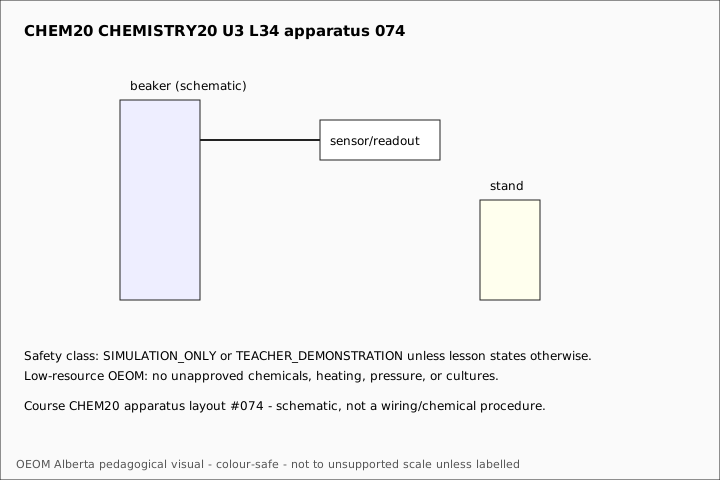
CHEM20 CHEMISTRY20 U3 L34 apparatus 074
Visual task (DURING_WORKED_EXAMPLE): Inspect the visual, notice labels, and answer the lesson prompt.
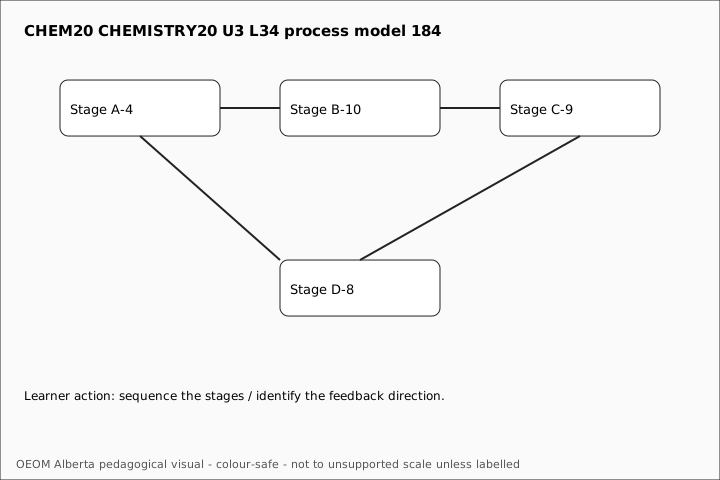
CHEM20 CHEMISTRY20 U3 L34 process model 184
Visual task (DURING_WORKED_EXAMPLE): Inspect the visual, notice labels, and answer the lesson prompt.
CHEM20 CHEMISTRY20 U3 L34 bonding model 294