Chemistry 20 - Acid-base industry and spills (STS)
LESSON = canonical instructional unit covering official Chemistry 20 outcomes. SESSION = bootcamp delivery event. A bootcamp session may overlay several Unit A lessons.
Canonical lesson CHEMISTRY20-U3-L33 · outcome 20-C2.2sts · depth CURRICULUM_BASELINE
Unit C: Solutions, Acids, Bases and Equilibrium intro - outcome 20-C2.2sts
- Course: CHEMISTRY20 (SCN2796)
- Lesson ID:
CHEMISTRY20-U3-L33 - Official outcome:
20-C2.2sts(STS) - Object type: canonical lesson (not a bootcamp session)
- Source: Alberta Chemistry 20 Program of Studies (2007, updated 2014)
Official outcome text
explain that technological problems often require multiple solutions that involve different designs, materials and processes and that have both intended and unintended consequences (ST3) [ICT F3-4.1] • provide examples of processes and products that use knowledge of acid and base chemistry (the pulp and paper industry, the petrochemical industry, food preparation and preservation, cleaning aids, sulfuric acid in car batteries, treating accidental acid or base spills using neutralization and dilution) • explain the significance of the strength and concentration of solutions in everyday life (pharmaceuticals, chemical spills, transportation of dangerous goods, toxicity) • identify examples in Alberta in which holistic practices used by some Aboriginal communities can be used to moderate the impact of development in industries such as the petrochemical industry
Learning intention
Meet 20-C2.2sts with instruction, practice, and a check. The 10-session bootcamp does not replace this lesson.
Success criteria
- Restate the outcome in classroom language without swapping in a different unit’s template.
- Complete the worked-style task for this outcome.
- Name the lab setting (classroom-supervised / teacher demo / dataset or simulation / forbidden).
Teaching
Acid-base chemistry appears in pulp/paper, petrochemical, food, batteries, and spill response (dilution/neutralization by trained people). Strength vs concentration matters for toxicity and transport. Alberta Aboriginal holistic-practice examples need FNMI_LOCAL_REVIEW - do not invent.
Worked example
Case card: sulfuric acid in a car battery - strong acid, high hazard; neutralization of a small school spill follows teacher WHMIS SOP, not student improvisation. Student: distinguish strength vs concentration with HCl examples on the card.
Guided practice
- Strength vs concentration T-chart with card numbers.
- Near-miss: inventing an FNMI petrochemical story. Hold review.
Independent practice
- One pulp/paper or food-preservation example from POS list in your words.
- Two sentences: multiple technological solutions (ST3).
- TDG/WHMIS awareness sentence.
Diagram / whiteboard
Approved diagram id chem20-ph-scale - pH scale / solution concentration axes. Tutor may open the course whiteboard and display this id. Do not invent hazardous procedures on the board.
Checks for understanding
Use the formative evidence below as the exit check for this outcome. Correct the misconception named in this lesson before praising.
Misconception to repair
Student-led neutralization of unknown industrial spills.
Safety and lab register
Setting: Teacher SOP for spills. Students do not neutralize unknowns. AI Tutor must not invent labs outside CHEM20_LOW_RESOURCE_LAB_REGISTER.csv.
Alberta Poison Control if a real exposure is occurring: 1-844-764-7669. The AI Tutor is not a poison centre.
Formative evidence
Strength/concentration chart + one industry example.
This is not a diploma. Mastery needs instruction + activity + check.
AI Tutor / human tutor
Ground on 20-C2.2sts. No false praise. No invented procedures. No silent skip to a different unit. Human tutor if the student describes mixing bleach, tasting, or flames.
Provenance
Official POS wording from ALBERTA_SENIOR_HIGH_OFFICIAL_OUTCOMES.csv. Pack lesson written to replace Wave-4 contaminated canonical markdown.
Visual task (BEFORE_WORKED_EXAMPLE): Compare particle arrangements before predicting a property.
CHEM20 CHEMISTRY20 U3 L33 particle model 073
Visual task (BEFORE_WORKED_EXAMPLE): Inspect the visual, notice labels, and answer the lesson prompt.
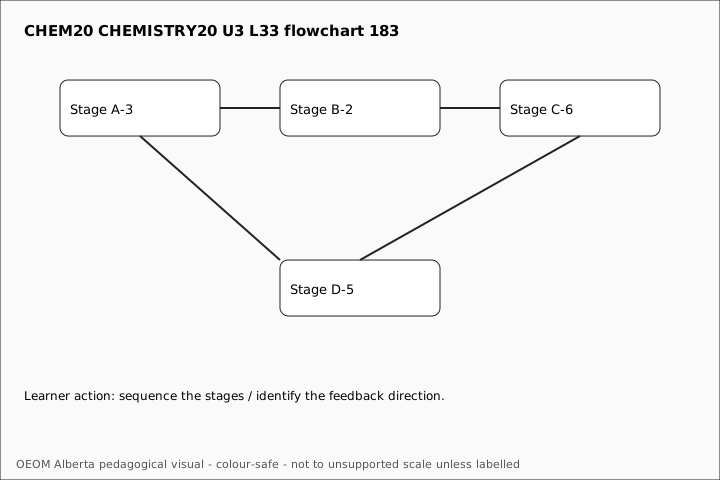
CHEM20 CHEMISTRY20 U3 L33 flowchart 183
Visual task (BEFORE_WORKED_EXAMPLE): Interpret the graph and state slope/intercept or trend.
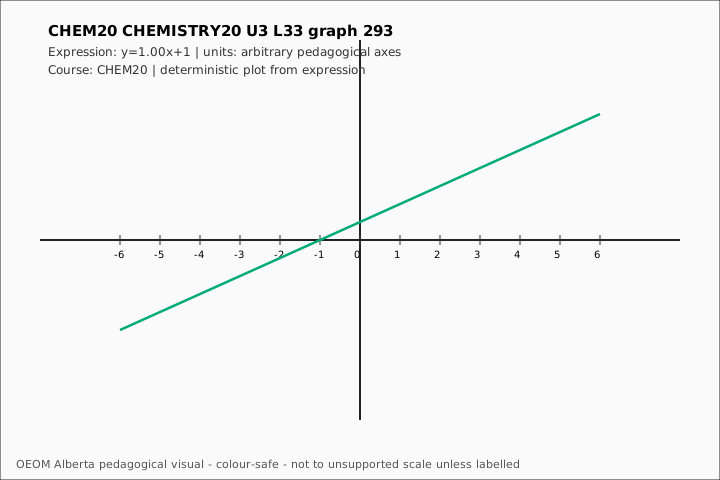
CHEM20 CHEMISTRY20 U3 L33 graph 293