Chemistry 20 - Communicate solution results
LESSON = canonical instructional unit covering official Chemistry 20 outcomes. SESSION = bootcamp delivery event. A bootcamp session may overlay several Unit A lessons.
Canonical lesson CHEMISTRY20-U3-L20 · outcome 20-C1.4s · depth CURRICULUM_BASELINE
Unit C: Solutions, Acids, Bases and Equilibrium intro - outcome 20-C1.4s
- Course: CHEMISTRY20 (SCN2796)
- Lesson ID:
CHEMISTRY20-U3-L20 - Official outcome:
20-C1.4s(SKILL) - Object type: canonical lesson (not a bootcamp session)
- Source: Alberta Chemistry 20 Program of Studies (2007, updated 2014)
Official outcome text
work collaboratively in addressing problems and apply the skills and conventions of science in communicating information and ideas and in assessing results • compare personal concentration data with the data collected by other individuals or groups (CT-SEC4) • select and use appropriate numeric, symbolic, graphical and linguistic modes of representation to communicate ideas, plans and results (CT-NS2) • use integrated software effectively and efficiently to incorporate data, graphics and text (CT-ST2) [ICT P4-4.3] • conduct, collectively, a risk-benefit analysis of the pollution of waterways by the release of effluents and propose a plan for reducing the impact on the ecosystem (IP-SEC3, AI-SEC3, CT-SEC1) [ICT F3-4.1]
Learning intention
Meet 20-C1.4s with instruction, practice, and a check. The 10-session bootcamp does not replace this lesson.
Success criteria
- Restate the outcome in classroom language without swapping in a different unit’s template.
- Complete the worked-style task for this outcome.
- Name the lab setting (classroom-supervised / teacher demo / dataset or simulation / forbidden).
Teaching
Compare concentration data across groups; use graphs/tables; optionally outline a waterway effluent risk-benefit discussion with given data - propose reduction ideas at student level.
Worked example
Group mean ± range for a class mol/L result. Soft skill: one agreed graph format. Effluent discussion uses pack numbers only.
Guided practice
- Compute class mean from a provided list.
- Near-miss: silent strand/unit switch into stoichiometry mass-mass. Stay on concentration communication.
Independent practice
- One graph of concentration vs group.
- Two sentences on effluent reduction ideas from the card.
- Software optional; paper ok.
Diagram / whiteboard
Approved diagram id chem20-ph-scale - pH scale / solution concentration axes. Tutor may open the course whiteboard and display this id. Do not invent hazardous procedures on the board.
Checks for understanding
Use the formative evidence below as the exit check for this outcome. Correct the misconception named in this lesson before praising.
Misconception to repair
Fabricating consensus by deleting outliers without reason.
Safety and lab register
Setting: Paper discussion of given environmental numbers. AI Tutor must not invent labs outside CHEM20_LOW_RESOURCE_LAB_REGISTER.csv.
Alberta Poison Control if a real exposure is occurring: 1-844-764-7669. The AI Tutor is not a poison centre.
Formative evidence
Class-mean report + one discussion paragraph.
This is not a diploma. Mastery needs instruction + activity + check.
AI Tutor / human tutor
Ground on 20-C1.4s. No false praise. No invented procedures. No silent skip to a different unit. Human tutor if the student describes mixing bleach, tasting, or flames.
Provenance
Official POS wording from ALBERTA_SENIOR_HIGH_OFFICIAL_OUTCOMES.csv. Pack lesson written to replace Wave-4 contaminated canonical markdown.
Visual task (REMEDIATION_ONLY): Inspect the visual, notice labels, and answer the lesson prompt.
Open table abv-chem20-0060 - CHEM20 CHEMISTRY20 U3 L20 table 060
Open full table (lazy). Alt: CHEM20 CHEMISTRY20 U3 L20 table 060. Full instructional table for CHEM20.
Visual task (REMEDIATION_ONLY): Match apparatus parts to the procedure steps (simulation/demo only).
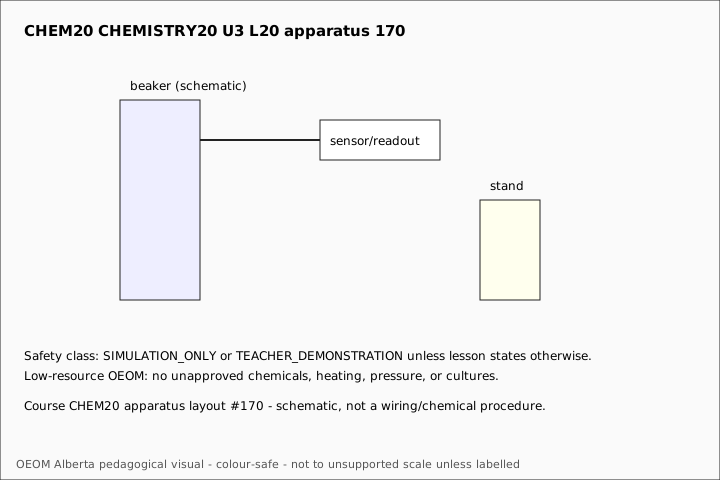
CHEM20 CHEMISTRY20 U3 L20 apparatus 170
Visual task (REMEDIATION_ONLY): Inspect the visual, notice labels, and answer the lesson prompt.
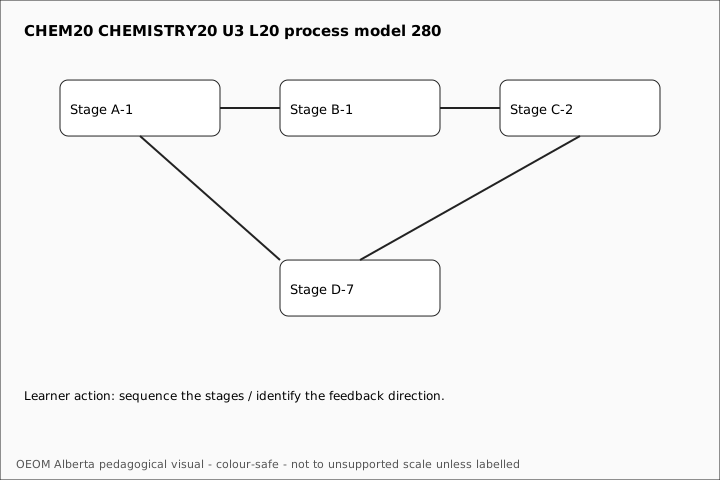
CHEM20 CHEMISTRY20 U3 L20 process model 280