Chemistry 20 - Safe limits and risk-benefit (STS)
LESSON = canonical instructional unit covering official Chemistry 20 outcomes. SESSION = bootcamp delivery event. A bootcamp session may overlay several Unit A lessons.
Canonical lesson CHEMISTRY20-U3-L16 · outcome 20-C1.5sts · depth CURRICULUM_BASELINE
Unit C: Solutions, Acids, Bases and Equilibrium intro - outcome 20-C1.5sts
- Course: CHEMISTRY20 (SCN2796)
- Lesson ID:
CHEMISTRY20-U3-L16 - Official outcome:
20-C1.5sts(STS) - Object type: canonical lesson (not a bootcamp session)
- Source: Alberta Chemistry 20 Program of Studies (2007, updated 2014)
Official outcome text
explain that the appropriateness, risks and benefits of technologies need to be assessed for each potential application from a variety of perspectives, including sustainability (ST7) [ICT F2-4.2, F3-4.1] • explain the role of concentration in risk-benefit analyses for determining the safe limits of particular substances, such as pesticide residues, heavy metals, chlorinated or fluorinated compounds and pharmaceuticals
Learning intention
Meet 20-C1.5sts with instruction, practice, and a check. The 10-session bootcamp does not replace this lesson.
Success criteria
- Restate the outcome in classroom language without swapping in a different unit’s template.
- Complete the worked-style task for this outcome.
- Name the lab setting (classroom-supervised / teacher demo / dataset or simulation / forbidden).
Teaching
Concentration drives risk-benefit decisions for pesticide residues, heavy metals, and pharmaceuticals (POS examples). Assess appropriateness and sustainability perspectives without giving medical advice.
Worked example
Scenario card: a drinking-water metal limit in ppm vs a lab reagent mol/L. Student: risk if above limit; benefit of the original use; one mitigation (treatment, substitution) from the card.
Guided practice
- Complete the scenario table: limit, measured (given), action.
- Near-miss: “drink less water” as the only mitigation. Improve it.
Independent practice
- Second scenario from the card set.
- Two sentences: ST7 multiple perspectives.
- AI Tutor must not invent exposure treatments - poison control number only if real exposure.
Diagram / whiteboard
Approved diagram id chem20-ph-scale - pH scale / solution concentration axes. Tutor may open the course whiteboard and display this id. Do not invent hazardous procedures on the board.
Checks for understanding
Use the formative evidence below as the exit check for this outcome. Correct the misconception named in this lesson before praising.
Misconception to repair
Giving personal medical dosing advice.
Safety and lab register
Setting: Paper scenarios. Real exposure → 1-844-764-7669; Tutor is not poison centre. AI Tutor must not invent labs outside CHEM20_LOW_RESOURCE_LAB_REGISTER.csv.
Alberta Poison Control if a real exposure is occurring: 1-844-764-7669. The AI Tutor is not a poison centre.
Formative evidence
One risk-benefit table completed from pack scenarios.
This is not a diploma. Mastery needs instruction + activity + check.
AI Tutor / human tutor
Ground on 20-C1.5sts. No false praise. No invented procedures. No silent skip to a different unit. Human tutor if the student describes mixing bleach, tasting, or flames.
Provenance
Official POS wording from ALBERTA_SENIOR_HIGH_OFFICIAL_OUTCOMES.csv. Pack lesson written to replace Wave-4 contaminated canonical markdown.
Visual task (DURING_LAB_ANALYSIS): Inspect the visual, notice labels, and answer the lesson prompt.
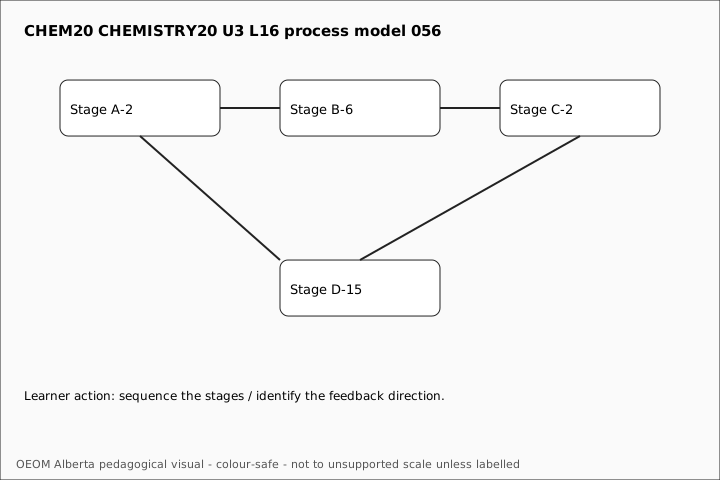
CHEM20 CHEMISTRY20 U3 L16 process model 056
Visual task (DURING_LAB_ANALYSIS): Inspect the visual, notice labels, and answer the lesson prompt.
CHEM20 CHEMISTRY20 U3 L16 bonding model 166
Visual task (DURING_LAB_ANALYSIS): Inspect the visual, notice labels, and answer the lesson prompt.
Open table abv-chem20-0276 - CHEM20 CHEMISTRY20 U3 L16 table 276
Open full table (lazy). Alt: CHEM20 CHEMISTRY20 U3 L16 table 276. Full instructional table for CHEM20.