Chemistry 20 - How concentration is expressed (STS)
LESSON = canonical instructional unit covering official Chemistry 20 outcomes. SESSION = bootcamp delivery event. A bootcamp session may overlay several Unit A lessons.
Canonical lesson CHEMISTRY20-U3-L13 · outcome 20-C1.2sts · depth CURRICULUM_BASELINE
Unit C: Solutions, Acids, Bases and Equilibrium intro - outcome 20-C1.2sts
- Course: CHEMISTRY20 (SCN2796)
- Lesson ID:
CHEMISTRY20-U3-L13 - Official outcome:
20-C1.2sts(STS) - Object type: canonical lesson (not a bootcamp session)
- Source: Alberta Chemistry 20 Program of Studies (2007, updated 2014)
Official outcome text
explain that science and technology have influenced, and been influenced by, historical development and societal needs (SEC2) [ICT F2-4.8] • compare the ways in which concentrations of solutions are expressed in chemistry laboratories, household products and environmental studies
Learning intention
Meet 20-C1.2sts with instruction, practice, and a check. The 10-session bootcamp does not replace this lesson.
Success criteria
- Restate the outcome in classroom language without swapping in a different unit’s template.
- Complete the worked-style task for this outcome.
- Name the lab setting (classroom-supervised / teacher demo / dataset or simulation / forbidden).
Teaching
Labs use mol/L; households use %; environment often uses ppm. Compare expressions for the same idea of “how much solute.”
Worked example
Same solute story: 1.00 g in 1.00 L water ≈ 1000 ppm ≈ 0.100% m/v approximate teaching numbers on a card - convert carefully with given assumptions.
Guided practice
- Convert a given % m/m to a qualitative “more/less concentrated than” statement vs a lab mol/L.
- Near-miss: using gas-law R in a concentration conversion. Wrong-unit.
Independent practice
- One household, one lab, one environmental expression for concentration.
- Two sentences: historical/societal influence on unit choice (SEC2) at a high level.
- Show one conversion with given numbers.
Diagram / whiteboard
Approved diagram id chem20-ph-scale - pH scale / solution concentration axes. Tutor may open the course whiteboard and display this id. Do not invent hazardous procedures on the board.
Checks for understanding
Use the formative evidence below as the exit check for this outcome. Correct the misconception named in this lesson before praising.
Misconception to repair
Treating % and ppm as interchangeable without showing the conversion basis.
Safety and lab register
Setting: Paper. No preparing unknown household mixtures. AI Tutor must not invent labs outside CHEM20_LOW_RESOURCE_LAB_REGISTER.csv.
Alberta Poison Control if a real exposure is occurring: 1-844-764-7669. The AI Tutor is not a poison centre.
Formative evidence
Triptych: % / mol/L / ppm with one conversion.
This is not a diploma. Mastery needs instruction + activity + check.
AI Tutor / human tutor
Ground on 20-C1.2sts. No false praise. No invented procedures. No silent skip to a different unit. Human tutor if the student describes mixing bleach, tasting, or flames.
Provenance
Official POS wording from ALBERTA_SENIOR_HIGH_OFFICIAL_OUTCOMES.csv. Pack lesson written to replace Wave-4 contaminated canonical markdown.
Visual task (BEFORE_WORKED_EXAMPLE): Interpret the graph and state slope/intercept or trend.
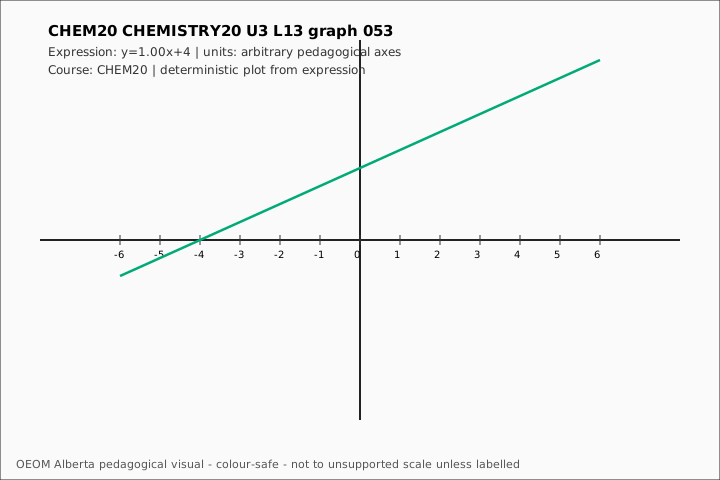
CHEM20 CHEMISTRY20 U3 L13 graph 053
Visual task (BEFORE_WORKED_EXAMPLE): Inspect the visual, notice labels, and answer the lesson prompt.
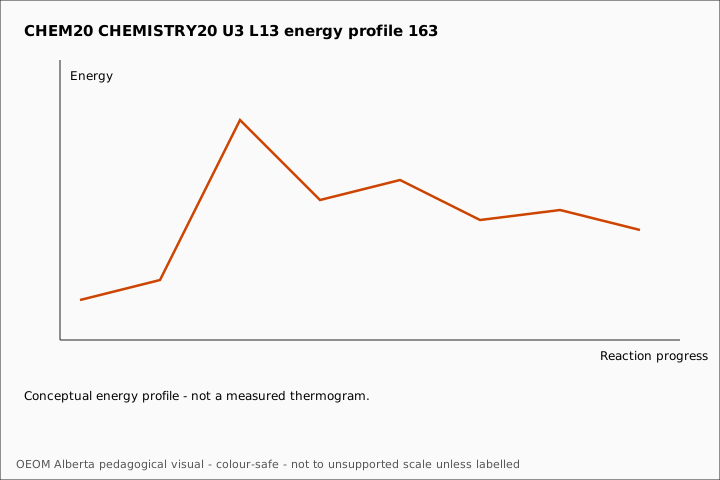
CHEM20 CHEMISTRY20 U3 L13 energy profile 163
Visual task (BEFORE_WORKED_EXAMPLE): Compare particle arrangements before predicting a property.
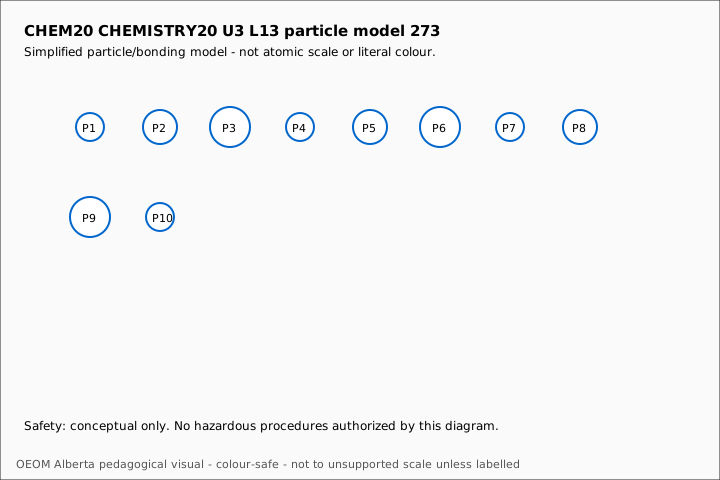
CHEM20 CHEMISTRY20 U3 L13 particle model 273