Chemistry 20 - Dilution
LESSON = canonical instructional unit covering official Chemistry 20 outcomes. SESSION = bootcamp delivery event. A bootcamp session may overlay several Unit A lessons.
Canonical lesson CHEMISTRY20-U3-L07 · outcome 20-C1.7k · depth CURRICULUM_BASELINE
Unit C: Solutions, Acids, Bases and Equilibrium intro - outcome 20-C1.7k
- Course: CHEMISTRY20 (SCN2796)
- Lesson ID:
CHEMISTRY20-U3-L07 - Official outcome:
20-C1.7k(KNOWLEDGE) - Object type: canonical lesson (not a bootcamp session)
- Source: Alberta Chemistry 20 Program of Studies (2007, updated 2014)
Official outcome text
calculate the concentrations and/or volumes of diluted solutions and the quantities of a solution and water to use when diluting
Learning intention
Meet 20-C1.7k with instruction, practice, and a check. The 10-session bootcamp does not replace this lesson.
Success criteria
- Restate the outcome in classroom language without swapping in a different unit’s template.
- Complete the worked-style task for this outcome.
- Name the lab setting (classroom-supervised / teacher demo / dataset or simulation / forbidden).
Teaching
Dilution: moles of solute stay constant if you only add solvent: c1V1 = c2V2. To prepare a more dilute solution, measure V1 of stock and add water to V2 (volumetric flask in school). Never add water to concentrated acid as a student home task; Chem 20 dilution math uses school-safe or paper numbers.
Worked example
25.0 mL of 2.00 mol/L stock diluted to 500. mL: c2 = (2.00)(0.0250)/0.500 = 0.100 mol/L. Volume of 6.00 mol/L needed to make 250 mL of 0.150 mol/L: V1 = 6.25 mL of stock, then dilute to 250 mL.
Guided practice
- What volume of 4.00 mol/L stock is needed to prepare 100.0 mL of 0.250 mol/L? Do not copy the 2.00→0.100 example.
- Near-miss: adding 100 mL of water to 100 mL of stock and calling it half concentration without using c1V1. (It is half if volumes additive - still show c1V1=c2V2.) If they omit V2 total, mark it.
Independent practice
- c2 after 10.0 mL of 1.50 mol/L diluted to 250.0 mL.
- Two sentences: why you dilute to the mark, not “add 250 mL of water to the pipet.”
- School volumetric flask vs kitchen jug - which setting?
Diagram / whiteboard
Approved diagram id chem20-ph-scale - pH scale / solution concentration axes. Tutor may open the course whiteboard and display this id. Do not invent hazardous procedures on the board.
Checks for understanding
Use the formative evidence below as the exit check for this outcome. Correct the misconception named in this lesson before praising.
Misconception to repair
Using M1V1 = M2V2 when a reaction consumes solute, or instructing “pour concentrated acid into a pop bottle.”
Safety and lab register
Setting: concentration and pH on paper or school-prepared dilute solutions. Red-cabbage indicator is classroom-supervised or photo/dataset. No concentrated acids or bases. No tasting. Dilution math is not a licence to mix cleaners. Forbidden: bleach+acid, drain opener, battery acid, undiluted pool chemicals. AI Tutor must not invent titrations or acid labs outside the register.
Alberta Poison Control if a real exposure is occurring: 1-844-764-7669. The AI Tutor is not a poison centre.
Formative evidence
One c1V1 = c2V2 numerical with mL→L consistent.
This is not a diploma. Mastery needs instruction + activity + check.
AI Tutor / human tutor
Ground on 20-C1.7k. No false praise. No invented procedures. No silent skip to a different unit. Human tutor if the student describes mixing bleach, tasting, or flames.
Provenance
Official POS wording from ALBERTA_SENIOR_HIGH_OFFICIAL_OUTCOMES.csv. Pack lesson written to replace Wave-4 contaminated canonical markdown.
Visual task (AFTER_PRACTICE): Inspect the visual, notice labels, and answer the lesson prompt.
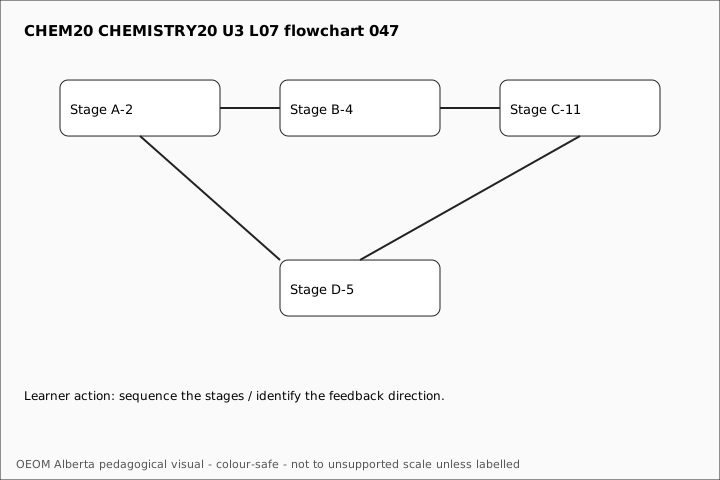
CHEM20 CHEMISTRY20 U3 L07 flowchart 047
Visual task (AFTER_PRACTICE): Interpret the graph and state slope/intercept or trend.
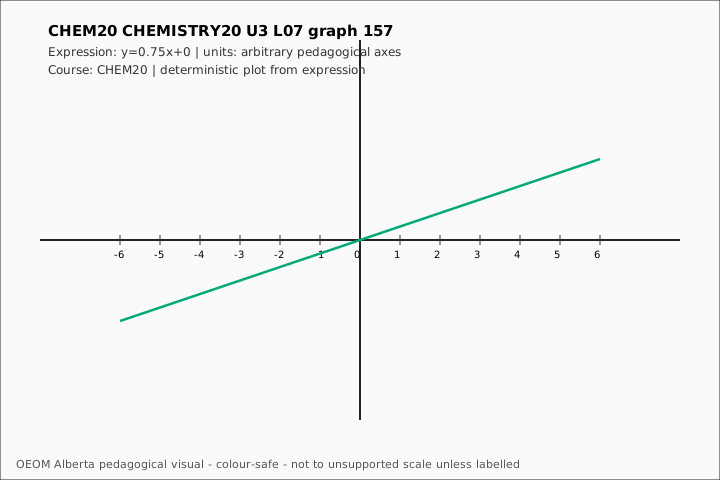
CHEM20 CHEMISTRY20 U3 L07 graph 157
Visual task (AFTER_PRACTICE): Inspect the visual, notice labels, and answer the lesson prompt.
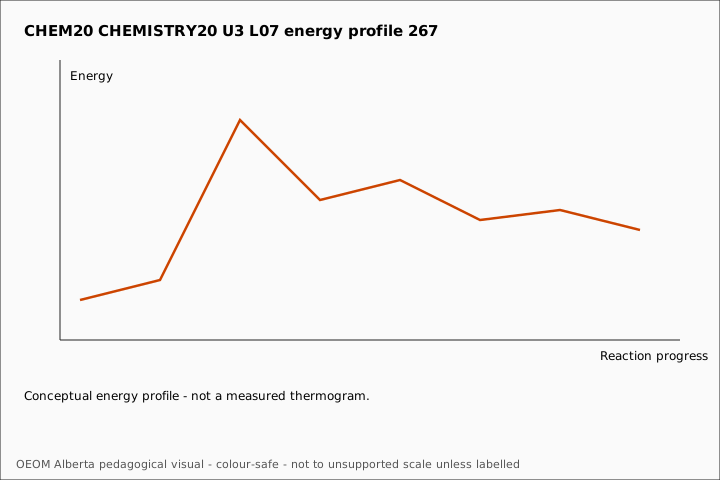
CHEM20 CHEMISTRY20 U3 L07 energy profile 267