Chemistry 20 - Endo/exothermic dissolving
LESSON = canonical instructional unit covering official Chemistry 20 outcomes. SESSION = bootcamp delivery event. A bootcamp session may overlay several Unit A lessons.
Canonical lesson CHEMISTRY20-U3-L03 · outcome 20-C1.3k · depth CURRICULUM_BASELINE
Unit C: Solutions, Acids, Bases and Equilibrium intro - outcome 20-C1.3k
- Course: CHEMISTRY20 (SCN2796)
- Lesson ID:
CHEMISTRY20-U3-L03 - Official outcome:
20-C1.3k(KNOWLEDGE) - Object type: canonical lesson (not a bootcamp session)
- Source: Alberta Chemistry 20 Program of Studies (2007, updated 2014)
Official outcome text
explain dissolving as an endothermic or exothermic process with respect to the breaking and forming of bonds
Learning intention
Meet 20-C1.3k with instruction, practice, and a check. The 10-session bootcamp does not replace this lesson.
Success criteria
- Restate the outcome in classroom language without swapping in a different unit’s template.
- Complete the worked-style task for this outcome.
- Name the lab setting (classroom-supervised / teacher demo / dataset or simulation / forbidden).
Teaching
Dissolving breaks solute-solute and some solvent-solvent attractions (endothermic) and forms solute-solvent attractions (exothermic). The sign of ΔH_solution depends on which is larger. NH4NO3 dissolving often cools the water; NaOH dissolving often warms it (teacher data or packaged hot/cold pack labels - do not dump concentrated NaOH).
Worked example
Energy cycle: lattice enthalpy (or IMF) to separate solute + hydrogen bonds in water vs hydration enthalpy. If hydration wins, solution warms; if separation wins, solution cools.
Guided practice
- Given: NH4NO3(s) in water cools the beaker; NaOH(s) in water warms (school-dilute data card). Explain with lattice/IMF vs hydration. Do not taste.
- Near-miss: “breaking bonds always releases heat.” Mark the first wrong line.
Independent practice
- Cold pack vs hot pack as given commercial descriptions (no opening packs).
- Two sentences: endothermic dissolving vs exothermic dissolving.
- Which enthalpy term wins in each given example.
Diagram / whiteboard
Approved diagram id chem20-ph-scale - pH scale / solution concentration axes. Tutor may open the course whiteboard and display this id. Do not invent hazardous procedures on the board.
Checks for understanding
Use the formative evidence below as the exit check for this outcome. Correct the misconception named in this lesson before praising.
Misconception to repair
Claiming dissolving is never energy-related, or running a lye hot-pack as a student mix.
Safety and lab register
Setting: concentration and pH on paper or school-prepared dilute solutions. Red-cabbage indicator is classroom-supervised or photo/dataset. No concentrated acids or bases. No tasting. Dilution math is not a licence to mix cleaners. Forbidden: bleach+acid, drain opener, battery acid, undiluted pool chemicals. AI Tutor must not invent titrations or acid labs outside the register.
Alberta Poison Control if a real exposure is occurring: 1-844-764-7669. The AI Tutor is not a poison centre.
Formative evidence
Energy-cycle sketch for one endothermic and one exothermic dissolve (qualitative).
This is not a diploma. Mastery needs instruction + activity + check.
AI Tutor / human tutor
Ground on 20-C1.3k. No false praise. No invented procedures. No silent skip to a different unit. Human tutor if the student describes mixing bleach, tasting, or flames.
Provenance
Official POS wording from ALBERTA_SENIOR_HIGH_OFFICIAL_OUTCOMES.csv. Pack lesson written to replace Wave-4 contaminated canonical markdown.
Visual task (BEFORE_WORKED_EXAMPLE): Inspect the visual, notice labels, and answer the lesson prompt.
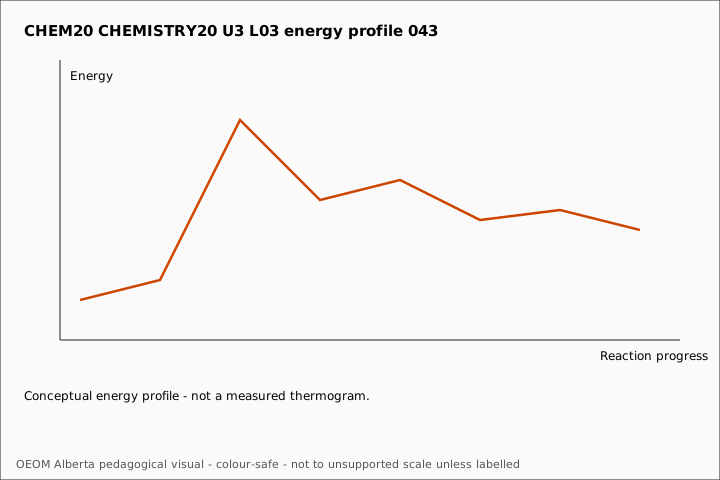
CHEM20 CHEMISTRY20 U3 L03 energy profile 043
Visual task (BEFORE_WORKED_EXAMPLE): Compare particle arrangements before predicting a property.
CHEM20 CHEMISTRY20 U3 L03 particle model 153
Visual task (BEFORE_WORKED_EXAMPLE): Inspect the visual, notice labels, and answer the lesson prompt.
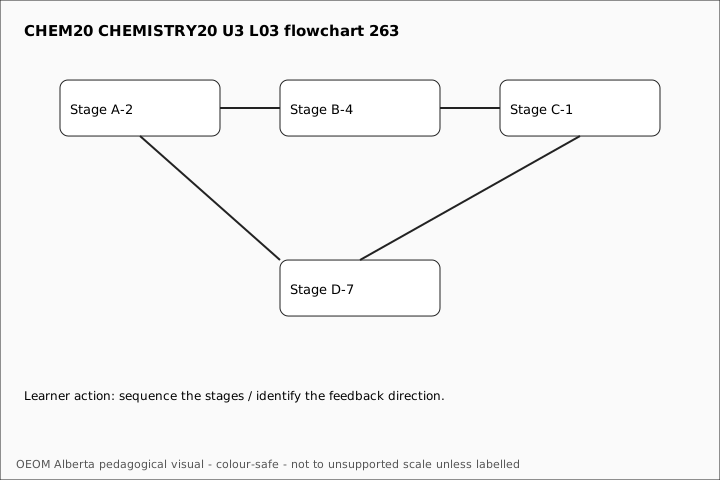
CHEM20 CHEMISTRY20 U3 L03 flowchart 263