Chemistry 20 - Gases in nature and technology (STS)
LESSON = canonical instructional unit covering official Chemistry 20 outcomes. SESSION = bootcamp delivery event. A bootcamp session may overlay several Unit A lessons.
Canonical lesson CHEMISTRY20-U2-L06 · outcome 20-B1.2sts · depth CURRICULUM_BASELINE
Unit B: Gases - outcome 20-B1.2sts
- Course: CHEMISTRY20 (SCN2796)
- Lesson ID:
CHEMISTRY20-U2-L06 - Official outcome:
20-B1.2sts(STS) - Object type: canonical lesson (not a bootcamp session)
- Source: Alberta Chemistry 20 Program of Studies (2007, updated 2014)
Official outcome text
explain that the goal of science is knowledge about the natural world (NS1) • describe examples of natural phenomena and processes and products (such as breathing, diffusion, weather, hot air balloons, scuba diving equipment, automobile air bags, gas turbines and internal combustion engines) that illustrate the properties of gases
Learning intention
Meet 20-B1.2sts with instruction, practice, and a check. The 10-session bootcamp does not replace this lesson.
Success criteria
- Restate the outcome in classroom language without swapping in a different unit’s template.
- Complete the worked-style task for this outcome.
- Name the lab setting (classroom-supervised / teacher demo / dataset or simulation / forbidden).
Teaching
Gases appear in breathing, weather, balloons, air bags, and engines. Describe properties (expandability, pressure) without performing hazardous demos.
Worked example
Map: phenomenon → gas property. Breathing ↔ volume/pressure; weather ↔ P changes; air bag ↔ rapid gas generation (engineering description only). Student adds hot-air balloon: Charles-law qualitative.
Guided practice
- Add scuba / depth pressure as a qualitative P increase example.
- Near-miss: generating H2 for balloons. Forbidden.
Independent practice
- Four phenomenon→property pairs.
- Two sentences: NS1 knowledge goal.
- No Aboriginal plant-weather claim invented - hold FNMI_LOCAL_REVIEW.
Diagram / whiteboard
Approved diagram id chem20-pv-boyle - P-V Boyle sketch (or gas law axes). Tutor may open the course whiteboard and display this id. Do not invent hazardous procedures on the board.
Checks for understanding
Use the formative evidence below as the exit check for this outcome. Correct the misconception named in this lesson before praising.
Misconception to repair
Deploying or dissecting an air bag.
Safety and lab register
Setting: Descriptions only. No gas generation, no air-bag handling. AI Tutor must not invent labs outside CHEM20_LOW_RESOURCE_LAB_REGISTER.csv.
Alberta Poison Control if a real exposure is occurring: 1-844-764-7669. The AI Tutor is not a poison centre.
Formative evidence
Four-row gas applications map.
This is not a diploma. Mastery needs instruction + activity + check.
AI Tutor / human tutor
Ground on 20-B1.2sts. No false praise. No invented procedures. No silent skip to a different unit. Human tutor if the student describes mixing bleach, tasting, or flames.
Provenance
Official POS wording from ALBERTA_SENIOR_HIGH_OFFICIAL_OUTCOMES.csv. Pack lesson written to replace Wave-4 contaminated canonical markdown.
Visual task (DURING_LAB_ANALYSIS): Inspect the visual, notice labels, and answer the lesson prompt.
Open table abv-chem20-0036 - CHEM20 CHEMISTRY20 U2 L06 table 036
Open full table (lazy). Alt: CHEM20 CHEMISTRY20 U2 L06 table 036. Full instructional table for CHEM20.
Visual task (DURING_LAB_ANALYSIS): Match apparatus parts to the procedure steps (simulation/demo only).
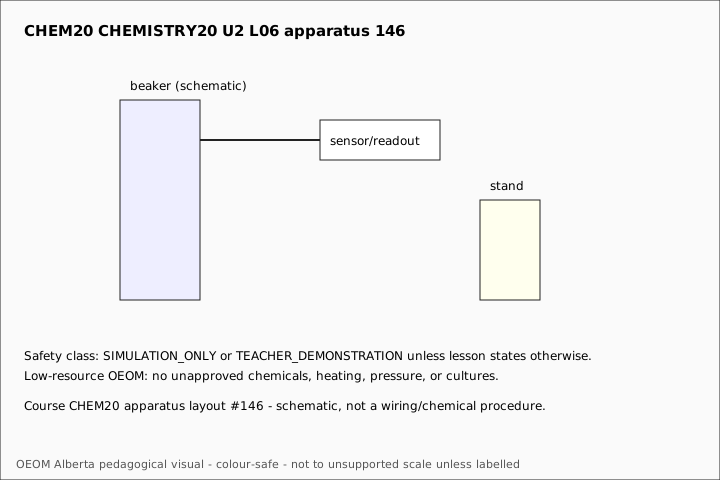
CHEM20 CHEMISTRY20 U2 L06 apparatus 146
Visual task (DURING_LAB_ANALYSIS): Inspect the visual, notice labels, and answer the lesson prompt.
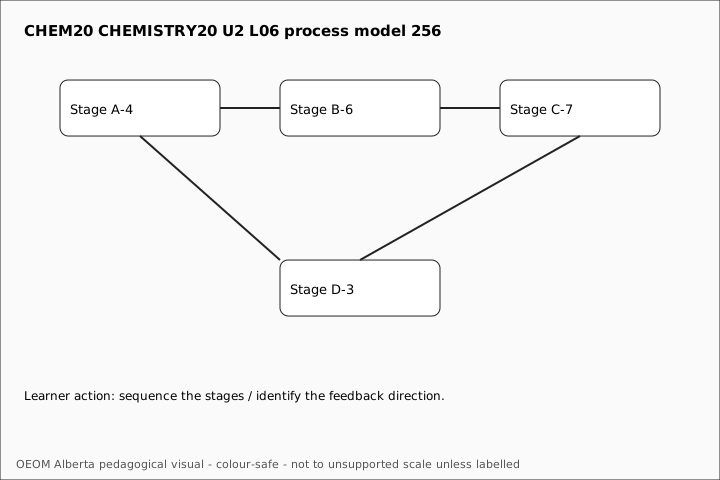
CHEM20 CHEMISTRY20 U2 L06 process model 256